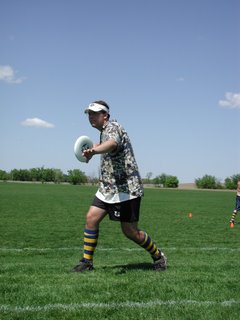
Ladies and Gentlemen, your attention please. Thank you all for coming. As we all know, tomorrow is March 15th, the day when it befits us to honor one of history's greatest personalities. No, not Julius Ceasar. I speak, of course, of Caleb M. Bartley.
Caleb was born in the small town of Mumblican in North Dakota, where his family earned their living by using superintelligent llamas to mine the rich veins of coal 12 miles east of the Bartley farmstead. Unlike the other families nearby, the Bartleys did not revere the sacred statue of Vishnu. Their household god was a hard day's work, and Young Caleb's first job came at the age of four, when he began teaching the llamas to differentiate between a live canary and a dead one. His adeptness with the young llamas would prove valuable later in life, when he would convince the heirs to both the Betty Crocker and Cargill fortunes that young children are not really that different from young llamas, and that he could be trusted with the duties of a nanny.
After the supply of coal was exhausted and the superintelligent llamas left to conquer Canada, Caleb and his family moved to St. Louis Park, Minnesota. As they drove to their new home, Caleb discovered the existence of hills, and resolved to be the first person to travel down them by means of stapling two thin boards to his shoes. His determination was redirected but not blunted when he discovered that downhill skiing was widespread and popular, and he quickly joined Blizzard Ski School. This proved especially fortuitous as Caleb was able to combine his newfound interest in skiing with his love of work. Blizzard affored Caleb the opportunity to first call other members in the area to see if they would be skiing that weekend, and later, when his skills improved, he worked as an instructor for younger children (again asserting the lack of difference between children and llamas). It was in the course of the former that Caleb made first unofficial contact with the Kreuser household, a coincidence that would later be remarked upon and marveled at but never explained. The fact that he later became peripherally acquainted with my sister, Kate, is generally dismissed as the Universe playing silly buggers with us all.
Upon moving to Minnesota, Caleb had been enrolled at Our Lady of Perpetual Sorrow: Benilde St. Margaret, a catholic school of some repute and resources. He benefitted from the finest education and hockey team money could buy, and his intelligence and resourcefullness often aided him in attempts to extricate himself from lockers, and subsequently fool around with the girls who helped him in out of said lockers. Caleb's school years were hard, because he had unfortunately been stricken with Youngitis, a disease that stunted his vertical growth (which would have otherwise topped 6'3") and caused his features to give him the youthful appearance of a twelve year old. However, Caleb was able to avoid the pitfalls of his ancestors, and did not marry his high school girlfriend. Instead, he used his undeniable intelligence and boyish charm to gain admission to Carleton College.
At Carleton, Caleb blossomed into a beautiful flower of a manly man. Paired with Jesse Belnap as a roommate, he formed half of the original Odd Couple: Caleb got up at 6am to go running, and Jesse slept until 2pm to give himself more time to smoke (both kinds), drink, and do his radio show. He also met the rest of the wacky gang of 1st Goodhue, which included myself, Andrew and Java. Deprived for the first time of a rigidly defined job, Caleb decided to make classwork his job: he kept track of all the time he spent going to class and doing homework, and if he was under 40 hours for the week, he would do flashcards to bring himself up to the required amount. It was this penchant for flashcards that first introduced me to the wonders of the Fubgangerzone (I believe Webster's now defines it as the place where gangs go to fight with nerf bats). And it was the German class that the flashcards were for that would introduce him to Yogi Reppmann, his German professor who initially asked Caleb to help him set up his computer. Little did Caleb realize that he would soon be negotiating shady international business deals and that Yogi would pimp him out to his ever-changing group of Hot German Chicks. Faced with the prospect of losing his only link to the world of technology and his most valuable gigolo at the end of the school year, Yogi was forced to kidnap Caleb and take him to Germany for the summer, where Caleb would defraud the German national telephone company, learn to love both beer and Cuban cigars, drive ridiculously fast cars and finally see Yogi naked. I believe that Caleb's love of international relations stems from this time, since he was forced, at several points, to use all his diplomatic skill to avoid creating an international incident. In exchange for not filing suit against the college, Caleb was accepted into the German off-campus studies program, where he spent fall term learning to enjoy beer even more. It was this love of beer and cigars that Caleb immediately imparted to me when I arrived in Munich for Joe & Caleb's Big Adventure. Eschewing my lack of health, he bought me a liter of beer and a cuban cigar the first night I was there, and I will say this: after drinking a liter of beer, I was feeling much better on the walk home than I was on the walk there. Over the next 7 days, we cut a glorious swath across the German countryside, annoying and confusing the natives, drinking enough beer to stun a Yak and being force-fed enough food to feed a town of starving Mongolians for a calendar year.
When Caleb and I returned from Germany to start Winter term at Carleton, little did we know that we, along with Java, Kathreen, the Sara(h)s and Andrew (when he returned from Mali), would form one of the most infamous rooms Carleton had ever seen. From our amazing adventures in the tunnels beneath Carleton and re-plumbing Caleb's cabin to our own section of the dorm staff meeting, the influence of Goodhue 414 was impressive. We were so prolific that when a friend of Caleb's from Germany came to visit us in the spring, he never saw us actually sleep. There are so many stories from that time that it would be folly to recount them all, but Caleb's involvement can be characterized by the moment when he suggested, at 3am on a Tuesday (or maybe Wednesday), that we should start watching a movie. Caleb pushed our carousing to the limit. I, seeking to do my part to help, acquired the habit of turning Caleb's alarm off in the mornings when it would go off for his 8:30am class.
Caleb continued to cause insanity for the rest of his Carleton career, whenever he was not writing insanely long papers for his advanced Poly Sci classes. Fortuneately, when he becomes famous and tries to deny everything, I have the photographic evidence to prove it all. After more or less taking Junior year off (except for organizing the U.S. branch of the Trip to Visit Joe in London, a trip whose insanity needs no recount here), Caleb was back in top form Senior year, causing fresh chaos with myself and Erik Hanberg as roommates. Nothing could deter Caleb in his quest to buy booze for the freshmen, help Erik hit on the freshmen, and then disappear to London for a weekend. Truly, Carleton will never forget this man who ruled the Rec Center with an iron fist. And if they try (presumably after Caleb gives them large amounts of money), I'll be right there to remind them.
And now, as Caleb turns 25 and is able to rent a car, he looks to the future. Having conquered the hillbilly yokels of Mizzera, he will soon earns MS in International Security and World Domination Studies. Caleb will then move to England, where he will labour to gain entrance into the secret Cabal of Powerful People who Rule the World. Fortuneately, Caleb's lifelong commitment to work will serve him well, and I predict that it will not be long before Caleb manically, yet studiously, runs the world from his office Hoboken, NJ. And if he gets everything done is less than 40 hours a week, he'll do flashcards to bring up his numbers.
So, ladies and gentlemen, I propose a toast: Happy Birthday to Caleb M. (which I think stands for Mountebank) Bartley. Loyal, outspoken, more than a little crazy, with a sometimes acerbic wit and a penchant for drinking beer and then beating up people who make comments about his sister. Caleb Bartley, my Friend. Happy Birthday.
Monday, March 14, 2005

Tuesday, March 08, 2005
Ong-Bak Review
I first heard about this movie on AICN. It got rave reviews at their annual movie marathon event, but I largely ignored it until I saw a trailer. Then I was hooked. I'm a big Jackie Chan fan, especially his earlier movies which involve ridiculous stunts and fight scenes. Jet Li is cool, but his movies tend to employ wire-fu to some extent or another, which is fine, as long as it's explained within the context of the movie. I like Chan more because, at least in all his early movies, it's actually him doing those stunts. He actually does jump across an alley from the top of a building onto a fire escape. He actually does hang from a helicopter. And he actually does all those cool fighting moves. So Ong-Bak was exciting for me because the star, Tony Jaa, was sold as the heir to that tradition of no stuntmen and no wires, and I'll be damned if it didn't deliver big-time.
First things first: don't go to this movie looking for plot. You'll find just enough to justify the crazy fight and chase scenes, but nothing more than that. Also, you'd be well advised to check any "He couldn't survive that" or "There's no way he could fight after that" attitude at the door, as there are several moments toward the end of the film where both the good and bad guys overcome serious injury to fight at what appears to be their peak ability. One last thing: I found the ending a little confusing. The head of Ong-Bak (the diety/Buddha of a small town that was stolen at the beginning of the movie) has been recovered, the bad guys vanguished, etc., but supposedly at the cost of one of the good guys. But then the scene switches back to the small village and the celebration that the head had to be recovered for. Riding on one of the elephants is someone who looks very much like the guy who you supposed dead a few seconds ago. But they don't confirm this in any way, and I was left wondering if it was that character, or just some monk who looked like him.
There, that's done.
Now, the reason to see this movie: it rocks. The action is fantastic: the fight scenes are very well done, and the chase scene in the middle has some of the most ridiculous stunts I've ever seen. You won't actually believe they did them at first, but the director thought of this problem and decided to show all of the most spectacular stunts in triplicate, and from different angles, just to convince you that absolutely no tickery was used to make it easier for Jaa. I can't even imagine what the blooper reel looks like, but it was worth it, because your jaw will hit the floor about a dozen times before you walk out of the theater. In that chase sequence, Jaa does flips off people, tables, cars, and everything else, jumps through a hoop of barbed wire not much bigger than a basketball hoop, does a sideways flip between two panes of glass that I probably couldn't even get through, and slides a truck by doing a full split, all at top speed. It's amazing. Then, there are the fight sequences. Brilliantly done with some of the most massive hits I've ever seen. I'm pretty sure a lot of stuntmen were very sore after filming this, because it looks like they erred on the side of judiciously hitting them as opposed to judiciously missing them. In fact, the realism is driven home in the first scene, where all the young men of this small village compete to see who can climb a tall tree, retrieve a flag at the top, and then get back down. No big deal, you say? Well, it would be if it weren't full contact tree climbing. The ground around the base of the tree has clearly been dug up, and if they were nice they put mattresses or something under the dirt, but it can't possibly have mattered that much when you still fall from 20 feet in the air, sometimes hitting many large branches on the way down.
This is Tony Jaa's first movie, so it's a little early to crown him as the next great martial arts star, but with the stuff he pulled off in Ong-Bak, you'd be crazy to say that he couldn't be. His next movie, Tom Yum Goong, is filming now (according to IMDB), so I suggest we all wait until we've seen a little bit more of him before the inevitable Jaa vs Chan vs Li vs Lee questions come up. Be careful if you're squeamish about seeing people's heads get cracked by an elbow, but if you like action movies at all, Ong-Bak is the best pure action you're likely to see for a while.
First things first: don't go to this movie looking for plot. You'll find just enough to justify the crazy fight and chase scenes, but nothing more than that. Also, you'd be well advised to check any "He couldn't survive that" or "There's no way he could fight after that" attitude at the door, as there are several moments toward the end of the film where both the good and bad guys overcome serious injury to fight at what appears to be their peak ability. One last thing: I found the ending a little confusing. The head of Ong-Bak (the diety/Buddha of a small town that was stolen at the beginning of the movie) has been recovered, the bad guys vanguished, etc., but supposedly at the cost of one of the good guys. But then the scene switches back to the small village and the celebration that the head had to be recovered for. Riding on one of the elephants is someone who looks very much like the guy who you supposed dead a few seconds ago. But they don't confirm this in any way, and I was left wondering if it was that character, or just some monk who looked like him.
There, that's done.
Now, the reason to see this movie: it rocks. The action is fantastic: the fight scenes are very well done, and the chase scene in the middle has some of the most ridiculous stunts I've ever seen. You won't actually believe they did them at first, but the director thought of this problem and decided to show all of the most spectacular stunts in triplicate, and from different angles, just to convince you that absolutely no tickery was used to make it easier for Jaa. I can't even imagine what the blooper reel looks like, but it was worth it, because your jaw will hit the floor about a dozen times before you walk out of the theater. In that chase sequence, Jaa does flips off people, tables, cars, and everything else, jumps through a hoop of barbed wire not much bigger than a basketball hoop, does a sideways flip between two panes of glass that I probably couldn't even get through, and slides a truck by doing a full split, all at top speed. It's amazing. Then, there are the fight sequences. Brilliantly done with some of the most massive hits I've ever seen. I'm pretty sure a lot of stuntmen were very sore after filming this, because it looks like they erred on the side of judiciously hitting them as opposed to judiciously missing them. In fact, the realism is driven home in the first scene, where all the young men of this small village compete to see who can climb a tall tree, retrieve a flag at the top, and then get back down. No big deal, you say? Well, it would be if it weren't full contact tree climbing. The ground around the base of the tree has clearly been dug up, and if they were nice they put mattresses or something under the dirt, but it can't possibly have mattered that much when you still fall from 20 feet in the air, sometimes hitting many large branches on the way down.
This is Tony Jaa's first movie, so it's a little early to crown him as the next great martial arts star, but with the stuff he pulled off in Ong-Bak, you'd be crazy to say that he couldn't be. His next movie, Tom Yum Goong, is filming now (according to IMDB), so I suggest we all wait until we've seen a little bit more of him before the inevitable Jaa vs Chan vs Li vs Lee questions come up. Be careful if you're squeamish about seeing people's heads get cracked by an elbow, but if you like action movies at all, Ong-Bak is the best pure action you're likely to see for a while.
Consciousness, Pericles, and a new Philosophical Theorem
Consciousness is a strange thing. It is our greatest attribute and the one most taken for granted. We live everyday with perhaps the most inscrutable facet of ourselves, the one thing that makes everything else possible. Some of us use it to push the boundary of what we know and understand about the universe. Some create amazing works of art that teach us about ourselves. Some of us look inward, and examine the depths of that consciousness. And some of us watch Jerry Springer and then catch an early showing of Son of the Mask. It took thousands of years of human history before Rene Descartes boiled philosophy and consciousness down to its simplist form in 1637: "I think therefore I am." It doesn't get more basic than that.
That, of course, is all well and good. But as important as thinking and being is, it does confine you to a rather lonely existence. Which is why Descartes immediately followed his first statement with his second: "I get mail, therefore I am." This worked well until the 1990s and the advent of the internet, when it had to be amended to "I get email, therefore I am." I certainly remember checking both my email inbox and Carleton mailbox at every possible opportunity, to see if some new proof of my existence and importance had arrived. But, my friends, I have recently discovered a new form of existential verification that Descartes neglected, possibly because he lived in seclusion in Holland for 20 years. I do not doubt that this form of verification has been discovered and know before this point, but, as I am gloriously unfamiliar with philosophic writings, I will describe to you how I came upon my therom: "I get recognized in bars, therefore I am."
But first, I will give a brief account of the Guthrie Lab's presentation of Pericles. I wrote my review of the text of the play earlier, and I must say the adaptation on the stage took me a little by surprize. The set was excellent. Versital, interesting, familiar and exotic as the scene required. The costumes were also excellent, and here we come to the first, and most notable, aspect of the production. Pericles, through a series of travels, comes to several (I think a total of six) different countries, and the production showed the change in scenery by radically different costumes (which were fantastic) and accents. The accents and mannerisms took a while to get used to, since that didn't really occur to me while I was reading the play. But I realized that it was the best way to show the differing cultures the play was set in, and I admired the international feel that it gave the performance. The dramatis persona was pared down to a meager 17 characters, which was handled by a total of eight actors, who did an excellent job of jumping back and forth. All the characters are played a little over the top, which can often end in disaster. But the director clearly knew what he was doing, and brought the actors right up to the point where their performance gave the play just the hint of the ridiculousness that it needed. It's a long way down for an overacted play: Joel Sass (the director) takes Pericles up to that cliff, takes a long look down, but ultimately decides not to jump. The play succeeds in being colorful and silly without losing its dignity. Of all the characters, I was most surprised how much I was impressed with Gower, an English poet who was a contemporary of Chaucer that Shakespeare resurrects to play the Chorus. The performance (by an actor who I first saw at the Lab in an excellent turn as Othello) was lively, and Sass weaves Gower into the fabric of the action, as opposed to leaving him out in the cold to stand on his own. But what perhaps impressed me most were his actual lines. You would think that I would have gotten that out of the text, but clearly these lines (like so many of Shakespeare) were meant to be read aloud. Gower's rhymes frame the action with a lightheartnedness that belies the seriousness of some of the sequences on stage, and give you the idea that everything is going to end up okay.
But now I come to the meat of this particular post. As some of you know, perhaps my favorite bar in Minneapolis is the Monte Carlo, discovered before the aforementioned Othello performance at the Lab, when we had an hour to kill and wanted something to drink. I have now been there several times, and have kept the tradition of going either before or after Lab performances. It's a fantastic, old school bar and restaraunt. Atmosphere to the rafters but an easy and welcoming style. About half or 2/3 of the public space is given over to dining room seating, but the heart of the Monte Carlo is the bar. About 20 feet long with a copper top, the bar occupies the front of the restaurant and is pretty much all you see looking in from the front window. Running the length of the bar is a mirrored wall that is covered with four long glass shelves, stocked with a plethora of liquor that would be more than sufficient to drop any elephant that had the mischance to wander in and order a drink. I'm always dazzeled by the array of vodkas, gins, tequilas and other hard liquors (including at least three brands of the Scandinavian Akvavit), but when you put me in a bar that makes me feel like I should be wearing a pin stripe suit, a fedora and smoking an extremely expensive cigar, there's only one thing I'll really want to drink. I may start off with a martini, I may order something else, but what I really want is a shot at the largest collection of single malt scotch I've seen in a bar outside of Scotland. And it is therefore fitting that scotch is the reason I can tell you this story.
The last time I had been to the Monte Carlo was about 3-4 weeks ago. Java and I were celebrating the clearing of a number of boxes and packaging materials from his company's downtown offices, and in appreciation they expensed our little dinner. Freed from financial constraints, I ordered a cucumber-infused Hendrik's Gin martini, and then two glasses of scotch. It was the scotch (first a Highland Park and then Oban) that caught the server's attention, and he spent a few moments chatting with me about scotch. Nothing major, just a few remarks that showed he knew what he was talking about.
So. Java and I enter the Monte Carlo after the play, ready to enjoy not only their fine selection of alcohol but also their fantastic teryaki green beans. We sit down on the end of the bar, facing in toward the restuarant. One of the two waiters behind the bar comes up and asks us what we would like. Java orders a vodka tonic. I reply that I want a glass of scotch, but I don't know what kind yet. The waiter gets Java's vodka tonic, sets it down in front of him, turns to me and says: "You were liking the Highlands and the Islays the last time." Being the master of observation, I quickly realize that it is the same waiter we had several weeks ago, and that, against all probability and odds, he has remembered me. "Yes," I replied. "Have you ever tried Lagavulin?" (Pronounced lagga-voolin, and yes, I had to look this up.) "No," I answered, still stunned that this guy (who couldn't possibly have been more than a year or two older than us, if that) remembered me and what I drank a month ago. "Let me get you a glass of that..." And so began my life after being recognized in a bar. And not just any bar, but one of the best I've ever been in. Like finding email in your inbox or a laminated card letting you know you have a package waiting for you, it's one of those experiences in life that makes you feel important. I stumbled into it totally by accident, by virtue of endearing myself to the waiter by ordering from his area of expertise. It's all well and good to go along thinking and being, but every once in awhile it's nice to get some outside confirmation.
That, of course, is all well and good. But as important as thinking and being is, it does confine you to a rather lonely existence. Which is why Descartes immediately followed his first statement with his second: "I get mail, therefore I am." This worked well until the 1990s and the advent of the internet, when it had to be amended to "I get email, therefore I am." I certainly remember checking both my email inbox and Carleton mailbox at every possible opportunity, to see if some new proof of my existence and importance had arrived. But, my friends, I have recently discovered a new form of existential verification that Descartes neglected, possibly because he lived in seclusion in Holland for 20 years. I do not doubt that this form of verification has been discovered and know before this point, but, as I am gloriously unfamiliar with philosophic writings, I will describe to you how I came upon my therom: "I get recognized in bars, therefore I am."
But first, I will give a brief account of the Guthrie Lab's presentation of Pericles. I wrote my review of the text of the play earlier, and I must say the adaptation on the stage took me a little by surprize. The set was excellent. Versital, interesting, familiar and exotic as the scene required. The costumes were also excellent, and here we come to the first, and most notable, aspect of the production. Pericles, through a series of travels, comes to several (I think a total of six) different countries, and the production showed the change in scenery by radically different costumes (which were fantastic) and accents. The accents and mannerisms took a while to get used to, since that didn't really occur to me while I was reading the play. But I realized that it was the best way to show the differing cultures the play was set in, and I admired the international feel that it gave the performance. The dramatis persona was pared down to a meager 17 characters, which was handled by a total of eight actors, who did an excellent job of jumping back and forth. All the characters are played a little over the top, which can often end in disaster. But the director clearly knew what he was doing, and brought the actors right up to the point where their performance gave the play just the hint of the ridiculousness that it needed. It's a long way down for an overacted play: Joel Sass (the director) takes Pericles up to that cliff, takes a long look down, but ultimately decides not to jump. The play succeeds in being colorful and silly without losing its dignity. Of all the characters, I was most surprised how much I was impressed with Gower, an English poet who was a contemporary of Chaucer that Shakespeare resurrects to play the Chorus. The performance (by an actor who I first saw at the Lab in an excellent turn as Othello) was lively, and Sass weaves Gower into the fabric of the action, as opposed to leaving him out in the cold to stand on his own. But what perhaps impressed me most were his actual lines. You would think that I would have gotten that out of the text, but clearly these lines (like so many of Shakespeare) were meant to be read aloud. Gower's rhymes frame the action with a lightheartnedness that belies the seriousness of some of the sequences on stage, and give you the idea that everything is going to end up okay.
But now I come to the meat of this particular post. As some of you know, perhaps my favorite bar in Minneapolis is the Monte Carlo, discovered before the aforementioned Othello performance at the Lab, when we had an hour to kill and wanted something to drink. I have now been there several times, and have kept the tradition of going either before or after Lab performances. It's a fantastic, old school bar and restaraunt. Atmosphere to the rafters but an easy and welcoming style. About half or 2/3 of the public space is given over to dining room seating, but the heart of the Monte Carlo is the bar. About 20 feet long with a copper top, the bar occupies the front of the restaurant and is pretty much all you see looking in from the front window. Running the length of the bar is a mirrored wall that is covered with four long glass shelves, stocked with a plethora of liquor that would be more than sufficient to drop any elephant that had the mischance to wander in and order a drink. I'm always dazzeled by the array of vodkas, gins, tequilas and other hard liquors (including at least three brands of the Scandinavian Akvavit), but when you put me in a bar that makes me feel like I should be wearing a pin stripe suit, a fedora and smoking an extremely expensive cigar, there's only one thing I'll really want to drink. I may start off with a martini, I may order something else, but what I really want is a shot at the largest collection of single malt scotch I've seen in a bar outside of Scotland. And it is therefore fitting that scotch is the reason I can tell you this story.
The last time I had been to the Monte Carlo was about 3-4 weeks ago. Java and I were celebrating the clearing of a number of boxes and packaging materials from his company's downtown offices, and in appreciation they expensed our little dinner. Freed from financial constraints, I ordered a cucumber-infused Hendrik's Gin martini, and then two glasses of scotch. It was the scotch (first a Highland Park and then Oban) that caught the server's attention, and he spent a few moments chatting with me about scotch. Nothing major, just a few remarks that showed he knew what he was talking about.
So. Java and I enter the Monte Carlo after the play, ready to enjoy not only their fine selection of alcohol but also their fantastic teryaki green beans. We sit down on the end of the bar, facing in toward the restuarant. One of the two waiters behind the bar comes up and asks us what we would like. Java orders a vodka tonic. I reply that I want a glass of scotch, but I don't know what kind yet. The waiter gets Java's vodka tonic, sets it down in front of him, turns to me and says: "You were liking the Highlands and the Islays the last time." Being the master of observation, I quickly realize that it is the same waiter we had several weeks ago, and that, against all probability and odds, he has remembered me. "Yes," I replied. "Have you ever tried Lagavulin?" (Pronounced lagga-voolin, and yes, I had to look this up.) "No," I answered, still stunned that this guy (who couldn't possibly have been more than a year or two older than us, if that) remembered me and what I drank a month ago. "Let me get you a glass of that..." And so began my life after being recognized in a bar. And not just any bar, but one of the best I've ever been in. Like finding email in your inbox or a laminated card letting you know you have a package waiting for you, it's one of those experiences in life that makes you feel important. I stumbled into it totally by accident, by virtue of endearing myself to the waiter by ordering from his area of expertise. It's all well and good to go along thinking and being, but every once in awhile it's nice to get some outside confirmation.
Friday, February 25, 2005
Constanticles: Reviews of Constantine and Pericles, plus a rant about the original Superman
Okay, so let me protect myself first by saying this: I've never read Hellblazer. I know, I'm a bad comic book fan. But it's true. In fact, it's only been relatively recently in my comic reading career that I've been branching out from Marvel to some of the more critically acclaimed series, but I've picked up Watchmen, Gaiman's Sandman (the first nine anyway), The League of Extraordinary Gentlemen, and the first two volumes of Hellboy. It's not much, but it's a start. In any case, I do plan to rectify the lack of Hellblazer in my collection, but suffice to say I went to see the movie without my traditional comic-knowledge background. I have no idea what the purists think, but that movie fuckin' rocked. It was fantastic. If you haven't already, you'll probably heard a fair number of mediocre-to-negative reviews. That's because people don't like Keanu. I'm not really sure why: I've never really had a big problem with him, provided he sticks to characters that fit his style. I've only seen him in Constantine, the Matrix movies, Much Ado about Nothing, The Replacements, and Speed. He does better with brooding characters who don't talk so much, and John Constantine is definately one of those. So if for some god-unknown reason you can't stand Keanu, don't see this movie, because he's in most of it (and he even has some lines). But he's far from bad, and has some fantastic scenes, particularily at the end. When Satan shows up at the climax, Keanu's offhand "hey Lu, what kept you?" sets up a final scene worth the price of admition.
You should see Constantine for the atmosphere, the style, and the visuals. The scenes in Hell are beautifully done, the pace is slow enough to build the tension nicely, and keeps you sufficiently in the dark (or at least it did me) for the ending to throw you a couple of curves that you might not be looking for. Perhaps more significant that anything else, this is DC's first good movie in a long, long time, and gives those of us waiting for Batman Begins and the Bryan Singer Superman movie a sign. A sign that DC (and its parent company, Warner Bros) can actually turn a comic book property into a good movie, ending a drought that began with (depending on who you talk to) Batman Forever or, well, the original Superman.
[I'm sorry, but I need to say this. In the comic book world it's widely accepted that Superman set the bar for superhero movies. That it made you believe a man could fly. Well, let me say this, after seeing it for the first time as an adult: Christopher Reeves is the only thing that movie has going for it. And he's amazing. He actually made me buy Superman/Clark's total lack of disguise (other than the glasses). His presence is phenominal. But other than that, Superman bites. And it's not the actors' fault. The script is horrible. The direction (and here I am speaking to the decision to have Gene Hackman play the most campy, ridiculous Lex Luthor I could have possibly conceived in my darkest dream) is awful. So. There, that's off my chest now. Thank you.]
To recap: Constantine good. Go see it, you'll like it. And if you didn't, don't blame me. There's obviously something wrong with you.
Now then, I also finished Shakespeare's Pericles a couple of days ago, in preparation for seeing it at the Guthrie Lab in the near future. Pericles is the first of the Romances, the genre which includes The Winter's Tale, Cymbeline and The Tempest. If you're reading a Shakespearian play with a happy ending that involves reuniting long-lost loves, involves major characters either being brough back to life or revealed to have not died in the first place and no revenge/retribution killings, you're almost certainly reading a romance (or at least in my experience you are). Pericles, prince of Tyre, goes around to some different cities, endures at least two major storms while en transit at sea, and gains, looses and gains a wife and daughter. He doesn't do anything wrong, he has no fatal personality flaw that makes him suffer. Bad shit just happens to him, which makes this one of Shakespeare's simpler plays. Which means, of course, there are 5-10 major angles you can analyze the play from as opposed to the standard 50 or so. At its most basic, I think you can describe the main point of Pericles like this: Life ends up throwing a lot of shit at you, even if you're a king. You can either give up and stop bathing and cutting your hair like Pericles, or you can keep on hoping, even without reason, and retain your virtue by convincing every John that comes to the brothel you've been sold to that they should give up whoring, thus driving the brothel out of business, like Marina (his daughter). Truly a lesson that applies to us all. Like I said, I've only read it at this point, so I'm interested in seeing how its staged. I'll be sure to let you know.
You should see Constantine for the atmosphere, the style, and the visuals. The scenes in Hell are beautifully done, the pace is slow enough to build the tension nicely, and keeps you sufficiently in the dark (or at least it did me) for the ending to throw you a couple of curves that you might not be looking for. Perhaps more significant that anything else, this is DC's first good movie in a long, long time, and gives those of us waiting for Batman Begins and the Bryan Singer Superman movie a sign. A sign that DC (and its parent company, Warner Bros) can actually turn a comic book property into a good movie, ending a drought that began with (depending on who you talk to) Batman Forever or, well, the original Superman.
[I'm sorry, but I need to say this. In the comic book world it's widely accepted that Superman set the bar for superhero movies. That it made you believe a man could fly. Well, let me say this, after seeing it for the first time as an adult: Christopher Reeves is the only thing that movie has going for it. And he's amazing. He actually made me buy Superman/Clark's total lack of disguise (other than the glasses). His presence is phenominal. But other than that, Superman bites. And it's not the actors' fault. The script is horrible. The direction (and here I am speaking to the decision to have Gene Hackman play the most campy, ridiculous Lex Luthor I could have possibly conceived in my darkest dream) is awful. So. There, that's off my chest now. Thank you.]
To recap: Constantine good. Go see it, you'll like it. And if you didn't, don't blame me. There's obviously something wrong with you.
Now then, I also finished Shakespeare's Pericles a couple of days ago, in preparation for seeing it at the Guthrie Lab in the near future. Pericles is the first of the Romances, the genre which includes The Winter's Tale, Cymbeline and The Tempest. If you're reading a Shakespearian play with a happy ending that involves reuniting long-lost loves, involves major characters either being brough back to life or revealed to have not died in the first place and no revenge/retribution killings, you're almost certainly reading a romance (or at least in my experience you are). Pericles, prince of Tyre, goes around to some different cities, endures at least two major storms while en transit at sea, and gains, looses and gains a wife and daughter. He doesn't do anything wrong, he has no fatal personality flaw that makes him suffer. Bad shit just happens to him, which makes this one of Shakespeare's simpler plays. Which means, of course, there are 5-10 major angles you can analyze the play from as opposed to the standard 50 or so. At its most basic, I think you can describe the main point of Pericles like this: Life ends up throwing a lot of shit at you, even if you're a king. You can either give up and stop bathing and cutting your hair like Pericles, or you can keep on hoping, even without reason, and retain your virtue by convincing every John that comes to the brothel you've been sold to that they should give up whoring, thus driving the brothel out of business, like Marina (his daughter). Truly a lesson that applies to us all. Like I said, I've only read it at this point, so I'm interested in seeing how its staged. I'll be sure to let you know.
Wednesday, February 23, 2005
Barbarella: Queen of the Galaxy!
Wow. So I finally watched this movie, courtesy of Mr. Java Fortran. And as I promised, here is my review. Yes, the interior of Barbarella's ship is entirely covered with shag carpeting. And yes, she does spend the entire first scene of the movie naked (not that you see anything). That should really tell you all you need to know about this movie, but just in case it doesn't, here's some more info:
Barbarella, played by Jane Fonda (who is amazingly hot in this movie-I had no idea), is never actually called the Queen of the Galaxy. She gets a call from Earth to go to a planet and look for an Earth scientist named (are you ready?) Duran Duran. That's right. And they say his full name all the time. Every time they did, I cracked up. It was great. You see, Duran Duran created a great weapon and then disappeared, making the Earth government worry that something might threaten the centuries of peace and love everyone had been enjoying. So Barbarella goes to this backward planet where they're a bunch of sadists and hedonists, quickly learns the upsides of having physical sex (as opposed to taking a pill and holding hands, which is what they do on Earth now) and becomes just a little bit of an addict. She does it with the first guy she meets when her ship crashes in the icy desert of the planet, she does it with the angel she meets when she gets to the city, she does it with a machine Duran Duran puts her in to torture and kill her, and she almost does it with the crazy BDSM chick who runs the planet's main city. It's really the backbone of the movie. In fact, I would go so far as to call this a movie about the feminist awakening of Jane Fonda to the pleasures of sex. Or maybe not.
In terms of things other than Barbarella doing it with different things, this is a quintessential B movie. Cheap production values, etc. But as long as you don't have a problem with that, there's absolutely no reason you can't get some good laughs from this movie. I know I did.
Barbarella, played by Jane Fonda (who is amazingly hot in this movie-I had no idea), is never actually called the Queen of the Galaxy. She gets a call from Earth to go to a planet and look for an Earth scientist named (are you ready?) Duran Duran. That's right. And they say his full name all the time. Every time they did, I cracked up. It was great. You see, Duran Duran created a great weapon and then disappeared, making the Earth government worry that something might threaten the centuries of peace and love everyone had been enjoying. So Barbarella goes to this backward planet where they're a bunch of sadists and hedonists, quickly learns the upsides of having physical sex (as opposed to taking a pill and holding hands, which is what they do on Earth now) and becomes just a little bit of an addict. She does it with the first guy she meets when her ship crashes in the icy desert of the planet, she does it with the angel she meets when she gets to the city, she does it with a machine Duran Duran puts her in to torture and kill her, and she almost does it with the crazy BDSM chick who runs the planet's main city. It's really the backbone of the movie. In fact, I would go so far as to call this a movie about the feminist awakening of Jane Fonda to the pleasures of sex. Or maybe not.
In terms of things other than Barbarella doing it with different things, this is a quintessential B movie. Cheap production values, etc. But as long as you don't have a problem with that, there's absolutely no reason you can't get some good laughs from this movie. I know I did.
Thursday, February 03, 2005
How to make a Joe-Improved Pizza
It's a classic: the Joe-Improved Pizza. If you've hung out with me when there's a kitchen and requisite ingredients around, you've probably had it. It's always gotten good reviews (so if you bastards were lying, it's your own fault), even though half-truths and semi-slandarous words have occasionally been spoken about the presence of charred carbon remnants where the cheese should be. So I thought I would toss the recipe up here in order to say that even you (yes you, Java) can make this extraordinary delectable delight yourself.
frozen pizza (count based on how many people you're trying to feed)
shredded mozzarella or block cheese
pepperoni
green and red bell peppers
yellow onion
thai chilies
garlic powder
basil leaves
The first step is to identify the type of frozen pizza that works well for you. For me, it's Jack's, but to each their own. Be aware that if you have a rising crust pizza it will take more time for the crust to cook and you may end up singeing the top. Preheating the oven is fine but not necessary. I suggest an arbitrary temperature somewhere in the range of 375-415, regardless of what it says on the pizza box (although definately on the high end with rising crusts). Now, I personally recommend starting with a sausage pizza. Spread the pepperoni to attain the desired coverage. Slice the onion and put on top of the pepperoni. Be sure to leave the rings whole-don't half them. The cut the bell peppers into strips about 1/2" wide and scatter among the onions. The thai chilies should be cut fairly small (maybe 1/4") and don't use more than three unless you really want to fry your mouth (an excellent alternative is to use pepperjack cheese instead). Spread (or grate and spread) the cheese, and feel free to mix in a few different types if you can (mozzarella, chedder and a little parmesean work well together). Then sprinkle the garlic powder and basil leaves over the cheese (I suggest a liberal application of garlic powder). Cook until about half of the mozzarella is brown. Remove, cut and wait a few minutes for it to cool down, because it's too hot right now and you'll burn the roof of your mouth. Then eat.
You may be wondering why I use garlic powder instead of fresh garlic. After several taste tests, I came to the conclusion that you get a more powerful garlic flavor by baking the powder directly into the cheese. Also, you're already chopping up a lot of things-give yourself a break. This is supposed to be easy, damn it!
frozen pizza (count based on how many people you're trying to feed)
shredded mozzarella or block cheese
pepperoni
green and red bell peppers
yellow onion
thai chilies
garlic powder
basil leaves
The first step is to identify the type of frozen pizza that works well for you. For me, it's Jack's, but to each their own. Be aware that if you have a rising crust pizza it will take more time for the crust to cook and you may end up singeing the top. Preheating the oven is fine but not necessary. I suggest an arbitrary temperature somewhere in the range of 375-415, regardless of what it says on the pizza box (although definately on the high end with rising crusts). Now, I personally recommend starting with a sausage pizza. Spread the pepperoni to attain the desired coverage. Slice the onion and put on top of the pepperoni. Be sure to leave the rings whole-don't half them. The cut the bell peppers into strips about 1/2" wide and scatter among the onions. The thai chilies should be cut fairly small (maybe 1/4") and don't use more than three unless you really want to fry your mouth (an excellent alternative is to use pepperjack cheese instead). Spread (or grate and spread) the cheese, and feel free to mix in a few different types if you can (mozzarella, chedder and a little parmesean work well together). Then sprinkle the garlic powder and basil leaves over the cheese (I suggest a liberal application of garlic powder). Cook until about half of the mozzarella is brown. Remove, cut and wait a few minutes for it to cool down, because it's too hot right now and you'll burn the roof of your mouth. Then eat.
You may be wondering why I use garlic powder instead of fresh garlic. After several taste tests, I came to the conclusion that you get a more powerful garlic flavor by baking the powder directly into the cheese. Also, you're already chopping up a lot of things-give yourself a break. This is supposed to be easy, damn it!
Tuesday, February 01, 2005
Did Eco write for Garfield & Friends?
Note: This review will contain revelations about the climax of The Name of the Rose. If you don't want things spoiled for you, go read the book really quick and them come back and read this post.
I picked up Eco's The Name of the Rose after a conversation I had with my good friend the Math Avenger. I had just finished The DaVinci Code and remarked to him that I had enjoyed the mystery and thought the ideas were intriguing, but found the writing to be pedestrian at best and groan-inducing at worst (there's one passage where the main character describes entering the Louvre as "walking into another world"). The Avenger recommended Eco as an alternative, saying that he found him to be similar in ideas but better in execution. After finishing the book last night, I must say I agree. Eco's style is much more cerebral and demands more attention from the reader. There are more characters, more subplots and more issues raised. Eco's writing is excellent: I'm not familiar at all with medieval writing styles, but Eco says in the postscript that he studied several manuscripts of the period so he could write as a monk of the period might write. I have no idea if he actually succeeded (in that I don't know what a scholar would think if you gave him a copy and asked him how close it was), but the narration was certainly in line with what I might expect out of that period, and it created the right tone and atmosphere for the novel. Before I get to what I actually want to talk about, let me just say that after a bit of a slow start where I had a lot of problems tracking all of the different sects of monks people were talking about, I really enjoyed this book. The characters are excellent (William is Sherlock Holmes as a monk in the 1300's), the mystery is fantastic, and the religious questions that are raised (particularily concerning heresy) really give you something to wrap your brain around, if that's the sort of thing that gets you going. The long descriptive passages, where Adso (the narrator) goes on at length about the various imagery he encounters reminded me first of Homer's long registry of Greek ships that sailed to Troy, and second of some of the more imagistic passages of The Faerie Queene. I did have one problem, which is that I have never read a book that would benefit so much from footnotes. Now a sort of mini-discussion about medieval religious sects would be great, and some of the imagery that pops up could definately use a gloss. But more than anything, I want the latin (and various other languages) translated. Do you know why? That's right, because I can't read Latin, and some very important lines in the book, including the last one that gives the book its title, are in Latin. So it drove me a little nuts, since I was looking for some closure on the book, and I didn't have the last line of the book! So that is my one major problem. You'd think that since the book was already translated from the Italian, it wouldn't be a problem for the guy to do a few more quick lines and just shove them down at the bottom somewhere. But my main purpose wasn't really to review the book, but to talk about one of the main ideas it brings up. (It's at this point that I'll start talking about the climax, so if you don't want to know what happens stop reading now.)
Early on in the book there are several conversations about the licitness of laughter, which take the form of the monks debating about whether or not laughter is something that should be recognized as holy or not. Although it comes up a couple times early in the book, my memory of it was overshadowed by discussions on the nature of heresy that dominate the later half of the novel. As I was approaching the climax, I found myself wondering what massively dangerous knowledge was in the mysterious book everyone kept chasing. Since the Math Avenger recommended this book as an alternative to The DaVinci Code, I figured it was some secret that would destroy the church, but I knew that it wouldn't be the same sort of revelation because there had been absolutely no preparation on that front (and anyway if the book said that Jesus was married and the apostles were sexists the monks would simply have dismissed it). I was initially confused by the revelation that this dangerous text is actually the second book of Aristotle's Poetics, where he describes the nature of laughter and comedy. But Jorge's explanation of why he feared a society with comedy elevated to an art form with the blessing of Aristotle was convincing and intriguing. An excellent payoff, and it started me thinking about what exactly laughter does for us.
Before I get to that, let me go back a few days, when I was at the beginning of the book, and had just read some of the early discussions about laughter. It so happened that, either that evening or the day after, I went to Java Fortran's apartment, and watched a particular episode of Garfield & Friends, one of the better saturday morning cartoons of my youth. One of the episodes featured a US Acres bit where group of aliens who have come to steal Earth's laughter, since it is a dangerous weapon on their planet (which is also why Jorge goes to such lengthes to keep the book secret). After a song describing what the world would be like without laughter, the aliens are defeated when the US Acres crew makes them laugh. Although obviously on a different level, I was struck by the fact that a children's cartoon show and a highly engaging but difficult historical novel shared this theme. What exactly does laughter do for us? There's a Calvin and Hobbes strip somewhere where Hobbes suggests that without laughter, we couldn't react to a lot in life. When I posed the question to Java this evening, he replied that the reason we laugh is to make ourselves happy. Douglas Adams considered P.G. Wodehouse one of the greatest English writers because of his sublime humor. In the G&F episode Orson says (sings) that life without laughter would be boring, and in Name of the Rose Jorge sees it as an uncivilized and ungodly response that would threaten the church if legitimized. William, on the other hand, notes that "laughter is proper to man, it is a sign of his rationality." I see laughter as a mental safety valve: a release that allows us to react to things that would otherwise confound us. In the fall of my sophomore year at Carleton, there were two evenings I stayed up all night playing Risk with some friends. Both times I ended up getting so punchy that something set me off and I literally fell off my chair laughing. Humor is a personal thing, in that what is funny for one may not be for another, or may be but to a different degree. The same person may find the same thing more or less funny depending on their mood. Laughter calms us down, makes us happy, and relieves stress. It can help us physiologically as well as mentally. Laughter helps our mind to counteract stress, tedium, disappointment and pretty much any other negative emotion you can come up with. It literally keeps us sane. If those space aliens had succeeded in stealing out laughter, we'd have much bigger problems that being bored all the time.
I'd love to hear any thoughts you might have on this subject. The weather here sucks (it was 45 damn degrees today) so I can't really bring myself to expound the benefits of winter. My other thoughts for today: Smallville rules, the Pats are going to win the Superbowl, and Pericles starts at the Guthrie Lab next weekend, so I'm going to get to read my first new Shakespeare in awhile.
I picked up Eco's The Name of the Rose after a conversation I had with my good friend the Math Avenger. I had just finished The DaVinci Code and remarked to him that I had enjoyed the mystery and thought the ideas were intriguing, but found the writing to be pedestrian at best and groan-inducing at worst (there's one passage where the main character describes entering the Louvre as "walking into another world"). The Avenger recommended Eco as an alternative, saying that he found him to be similar in ideas but better in execution. After finishing the book last night, I must say I agree. Eco's style is much more cerebral and demands more attention from the reader. There are more characters, more subplots and more issues raised. Eco's writing is excellent: I'm not familiar at all with medieval writing styles, but Eco says in the postscript that he studied several manuscripts of the period so he could write as a monk of the period might write. I have no idea if he actually succeeded (in that I don't know what a scholar would think if you gave him a copy and asked him how close it was), but the narration was certainly in line with what I might expect out of that period, and it created the right tone and atmosphere for the novel. Before I get to what I actually want to talk about, let me just say that after a bit of a slow start where I had a lot of problems tracking all of the different sects of monks people were talking about, I really enjoyed this book. The characters are excellent (William is Sherlock Holmes as a monk in the 1300's), the mystery is fantastic, and the religious questions that are raised (particularily concerning heresy) really give you something to wrap your brain around, if that's the sort of thing that gets you going. The long descriptive passages, where Adso (the narrator) goes on at length about the various imagery he encounters reminded me first of Homer's long registry of Greek ships that sailed to Troy, and second of some of the more imagistic passages of The Faerie Queene. I did have one problem, which is that I have never read a book that would benefit so much from footnotes. Now a sort of mini-discussion about medieval religious sects would be great, and some of the imagery that pops up could definately use a gloss. But more than anything, I want the latin (and various other languages) translated. Do you know why? That's right, because I can't read Latin, and some very important lines in the book, including the last one that gives the book its title, are in Latin. So it drove me a little nuts, since I was looking for some closure on the book, and I didn't have the last line of the book! So that is my one major problem. You'd think that since the book was already translated from the Italian, it wouldn't be a problem for the guy to do a few more quick lines and just shove them down at the bottom somewhere. But my main purpose wasn't really to review the book, but to talk about one of the main ideas it brings up. (It's at this point that I'll start talking about the climax, so if you don't want to know what happens stop reading now.)
Early on in the book there are several conversations about the licitness of laughter, which take the form of the monks debating about whether or not laughter is something that should be recognized as holy or not. Although it comes up a couple times early in the book, my memory of it was overshadowed by discussions on the nature of heresy that dominate the later half of the novel. As I was approaching the climax, I found myself wondering what massively dangerous knowledge was in the mysterious book everyone kept chasing. Since the Math Avenger recommended this book as an alternative to The DaVinci Code, I figured it was some secret that would destroy the church, but I knew that it wouldn't be the same sort of revelation because there had been absolutely no preparation on that front (and anyway if the book said that Jesus was married and the apostles were sexists the monks would simply have dismissed it). I was initially confused by the revelation that this dangerous text is actually the second book of Aristotle's Poetics, where he describes the nature of laughter and comedy. But Jorge's explanation of why he feared a society with comedy elevated to an art form with the blessing of Aristotle was convincing and intriguing. An excellent payoff, and it started me thinking about what exactly laughter does for us.
Before I get to that, let me go back a few days, when I was at the beginning of the book, and had just read some of the early discussions about laughter. It so happened that, either that evening or the day after, I went to Java Fortran's apartment, and watched a particular episode of Garfield & Friends, one of the better saturday morning cartoons of my youth. One of the episodes featured a US Acres bit where group of aliens who have come to steal Earth's laughter, since it is a dangerous weapon on their planet (which is also why Jorge goes to such lengthes to keep the book secret). After a song describing what the world would be like without laughter, the aliens are defeated when the US Acres crew makes them laugh. Although obviously on a different level, I was struck by the fact that a children's cartoon show and a highly engaging but difficult historical novel shared this theme. What exactly does laughter do for us? There's a Calvin and Hobbes strip somewhere where Hobbes suggests that without laughter, we couldn't react to a lot in life. When I posed the question to Java this evening, he replied that the reason we laugh is to make ourselves happy. Douglas Adams considered P.G. Wodehouse one of the greatest English writers because of his sublime humor. In the G&F episode Orson says (sings) that life without laughter would be boring, and in Name of the Rose Jorge sees it as an uncivilized and ungodly response that would threaten the church if legitimized. William, on the other hand, notes that "laughter is proper to man, it is a sign of his rationality." I see laughter as a mental safety valve: a release that allows us to react to things that would otherwise confound us. In the fall of my sophomore year at Carleton, there were two evenings I stayed up all night playing Risk with some friends. Both times I ended up getting so punchy that something set me off and I literally fell off my chair laughing. Humor is a personal thing, in that what is funny for one may not be for another, or may be but to a different degree. The same person may find the same thing more or less funny depending on their mood. Laughter calms us down, makes us happy, and relieves stress. It can help us physiologically as well as mentally. Laughter helps our mind to counteract stress, tedium, disappointment and pretty much any other negative emotion you can come up with. It literally keeps us sane. If those space aliens had succeeded in stealing out laughter, we'd have much bigger problems that being bored all the time.
I'd love to hear any thoughts you might have on this subject. The weather here sucks (it was 45 damn degrees today) so I can't really bring myself to expound the benefits of winter. My other thoughts for today: Smallville rules, the Pats are going to win the Superbowl, and Pericles starts at the Guthrie Lab next weekend, so I'm going to get to read my first new Shakespeare in awhile.
Monday, January 24, 2005
One Damn Long Post About Books
So if you've been paying attention to the "What I'm Reading" section of the sidebar, you've noticed that it's undergone some changes. I finished A Farewell to Arms, and have added three new books to the mix. Those of you who are astute will also realize this means that Fearful Symmetry and Pu-239 have hit the backburner a little bit. It's not my fault. Really. It's Christmas. You see, the holidays invariably mean presents. And as I am known for picking up the occasional printed word, I usually ask for and receive the odd book or two. This year saw the addition of no less than six books to my stable, and some of them were read during my long absense from posting, so they never appeared on my reading list. So I thought I would do something similar to my movies/dvd reviews and hit several of them in the same post, though with slightly longer reviews.
Before getting to the books I have completed, I must say a few words about one I'm still reading. My esteemed friend Mr. Hanberg sent me Harold Bloom's Genius, a profile of 100 literary figures from throughout history. I'm still just at the beginning, but I am thoroughly enjoying it and wanted to give it a quick plug. Bloom, in case you don't know, is one of the preeminent literary critics in America. His specialities are Shakespeare, Milton and the English Romantics, and after reading the introduction, etc. and the first several profiles, I have made an astounding discovery: Harold Bloom is smarter than me. I know, it was a shock to me too. There is, of course, the chance that he is not really inherently smarter than me, but merely vastly better educated and more well read. In either case, the insight he has demonstrated even through the 60-odd pages I've read so far is amazing. If you pick this book up, be advised that Bloom will not work to bring you up to speed. If you can't keep up with him, that's your affair, not his. But that's not a condemnation-just a warning. I would strongly recommend picking up this book if you get the chance. And now, some quick hits on the books I have actually finished reading.
A Farewell to Arms
I took a class at Carleton called 20th Century Literature. Although I didn't think about it at the time, the title was ridiculously vague. What the class really should have been called was Modernist Lit. In case you've forgotten what exactly Modernism is, don't feel bad. Aside from being able to tell you that it's generally seen as a reaction to the horrors of the first world war, I'm drawing a blank. But fortuneately for you, I have A Glossary of Literary Terms by the incomparable M.H. Abrams in my possession, and I just went out to my bookcase and got it. So let's see what it says...hmm. Ok, Abrams talks a lot in that book. Although there were precursors before WWI, the war caused a whole lot of really smart people to rethink "traditional bases not only of Western Art, but of Western cultuer in general. ...The catastrophe of the war had shaken faith in the moral basis, coherence, and durability of Western civilization and raised doubts about the adequacy of traditional literary modes to represent the harsh and dissonant realities of the postwar world." So they started to shuck the traditional literary forms. Some of these were more obvious than others-if you've ever read a book with a section that is stream-of-consciousness on paper, with no punctuation or anything, you've probably read a modernist work. The most famous writers of the early 20th century are almost all modernist to some extent or another.
All that was by way of saying that Hemingway was one of the authors we read in that class. His style, rather than taking narration to the extreme of telling you everything in the character's head, is to strip the narration down to its barest essentials. What comes through in Farewell is an extremely compelling look at war as seen by a young American serving in the Italian army as an ambulance driver. Hemingway stark presents the realities of the cost of the war through his descriptions of the columns of wounded soldiers slowly moving back from the front. The wholesale retreat described in the third quarter of the book is particularily brilliant, and scattered conversations about possible ends to the fighting indicate just how uncertain the characters (and Hemingway) are about this new form of war. All this is contrasted with Henry's (the main character is named Frederic Henry, which doesn't really come up all that much) love for an English nurse named Catherine Barkley. The ending, which I won't give away, is heartbreakingly appropriate in that it completes Hemingway's disillusionment by providing no hope for the future. Bloom says that great literature transcends it's age, and this book certainly does. I've found that appreciation of Hemingway will sometimes tend to break down along gender lines: men like him, women don't. But with our present militaristic atmosphere, this is definately a book I recommend you pick up, read, and think about. Because Hemingway's minimalistic style of prose demands reflection and consideration, since you need to see what he's leaving out along with what he leaves in.
ps A big thanks to Mr. Erik Hanberg for sending me this book for Christmas last year. I actually did finish it before having it for a full year, Erik.
Sandman vol. IX: The Kindly Ones
I'm not really going to review this in detail, since it's essentially the climax of the previous eight graphic novels of Neil Gaiman's opus about Morpheus, the King of Dreams. If you've never picked them up, the Sandman volumes are graphic novels (which, for those of you who don't know thing one about comics, are collections of comic books) that will totally sell you on comics as a storytelling medium at worst and an artistic medium at best. I would recommend Alan Moore's Watchmen first to someone who had never read comics only because it can be had in one single volume as opposed to ten. Gaiman, over the course of several novels, has proven himself a brilliant writer and storyteller, but Sandman remains his best work, and this volume brings everything together and Gaiman proves he has the skill to bring in all the existing plot threads, tie them up in a neat little bow and then cut them off with an axe. I highly recommend it (volume one is called Preludes & Nocturns, and you can order it on amazon).
Hitchhiker: A Biography of Douglas Adams
Those of you who know me know that Adams is one of my favorite authors. Not only the Hitchhiker's Guide books, but his two Dirk Gently novels and other works as well (one of his best novles is a little read non-fiction book called Last Chance to See. Pick it up if you get the chance and are at all environmentally inclined or curious). This biography by M.J. Simpson is exhaustively researched (and footnoted!) and detailed. He shows how some of the most commonly told stories about Douglas, stories that Douglas himself told hundreds of times to reporters, are not entirely accurate. Simpson's intent is not to expose Douglas as a liar, but to give us an better understanding of how his mind worked: Douglas was, above all else, a storyteller, who meticulously refined his books (when his editors gave him the time). He also, though not consciously, refined the stories that he had to tell over an over again in the course of hundreds of interviews. I won't go into more detail, simply because, in this book, there's too much detail to go into. I would only recommend this book if you're a fan of Adams' work. I suspect that a casual fan may find this book slow at times. But if you're interested in him, and I recommend reading The Salmon of Doubt to whet your appetite, pick this up and you'll learn most everything you could possibly want to know.
Joy in the Morning and Jeeves and the Tie that Binds
(note: The UK title of ...Tie that Binds is Much Obliged, Jeeves. So don't buy both.)
I learned P.G. Wodehouse existed through Douglas Adams. In the aforementioned Salmon of Doubt Adams cites Wodehouse as one of his greatest influences. So I decided to pick up something by Wodehouse. So the next time I was at B&N I went over the 'W' section. And there I found that Wodehouse had the entire lower shelf to himself. It was a sizeable shelf. So I went away defeated, since I didn't want to just buy something without some idea of what I was getting into. Some time after that I came across a copy of The World of Jeeves in a used bookstore, which purported to contain all of the short stories Wodehouse wrote about Bertie Wooster and his servant and savior Jeeves. I bought it, read it, and loved it. So much so that I sent a copy to my friend the Math Avenger for his birthday, and upon his completion he posted on his blog (linked in the sidebar) some insightful musings on Wodehouse and the volume in question which I urge you to check out. Anyway, in the aftermath of reading 34 short stories about Bertie and Jeeves I was left wanting more, and thus I picked up two of the eleven (by my count) novels covering the exploits of the original dynamic duo. Joy in the Morning is the better of the two, but that's in the way of praising it rather than putting down Tie that Binds. Both contain Wodehouse's immediately addictive style of writing and preternatural instinct for comic phrasing and timing, and Joy in the Morning triumphs only in that the situations Bertie finds himself thrown into are more fantastic than in the other novel. Both these books pick up on existing relationships that began either in the short stories or in other novels, so I highly recommend you at least read the short stories first, though if you don't Wodehouse does give you an update on previous event so as to not leave you out in the cold.
Since first reading Wodehouse, I find myself noticing quotes from people concerning the half-life of comedic novels. They do not age well, all the quotes say, unless the author's name happens to be Wodehouse. I thoroughly enjoyed these books and the short stories that preceded them. If you're looking for something to make you laugh that's well written with turns of phrase that will send you off your chair, look no further. Wodehouse is the answer.
So that's it for the books I've read recently. Right now I'm in the middle of The Name of the Rose, so I'll let you know when I'm done with that. I may take a break for a day or two, but I'll come back hopefully with some musings on MN's first big snowfall of the year, which happened last Friday.
Before getting to the books I have completed, I must say a few words about one I'm still reading. My esteemed friend Mr. Hanberg sent me Harold Bloom's Genius, a profile of 100 literary figures from throughout history. I'm still just at the beginning, but I am thoroughly enjoying it and wanted to give it a quick plug. Bloom, in case you don't know, is one of the preeminent literary critics in America. His specialities are Shakespeare, Milton and the English Romantics, and after reading the introduction, etc. and the first several profiles, I have made an astounding discovery: Harold Bloom is smarter than me. I know, it was a shock to me too. There is, of course, the chance that he is not really inherently smarter than me, but merely vastly better educated and more well read. In either case, the insight he has demonstrated even through the 60-odd pages I've read so far is amazing. If you pick this book up, be advised that Bloom will not work to bring you up to speed. If you can't keep up with him, that's your affair, not his. But that's not a condemnation-just a warning. I would strongly recommend picking up this book if you get the chance. And now, some quick hits on the books I have actually finished reading.
A Farewell to Arms
I took a class at Carleton called 20th Century Literature. Although I didn't think about it at the time, the title was ridiculously vague. What the class really should have been called was Modernist Lit. In case you've forgotten what exactly Modernism is, don't feel bad. Aside from being able to tell you that it's generally seen as a reaction to the horrors of the first world war, I'm drawing a blank. But fortuneately for you, I have A Glossary of Literary Terms by the incomparable M.H. Abrams in my possession, and I just went out to my bookcase and got it. So let's see what it says...hmm. Ok, Abrams talks a lot in that book. Although there were precursors before WWI, the war caused a whole lot of really smart people to rethink "traditional bases not only of Western Art, but of Western cultuer in general. ...The catastrophe of the war had shaken faith in the moral basis, coherence, and durability of Western civilization and raised doubts about the adequacy of traditional literary modes to represent the harsh and dissonant realities of the postwar world." So they started to shuck the traditional literary forms. Some of these were more obvious than others-if you've ever read a book with a section that is stream-of-consciousness on paper, with no punctuation or anything, you've probably read a modernist work. The most famous writers of the early 20th century are almost all modernist to some extent or another.
All that was by way of saying that Hemingway was one of the authors we read in that class. His style, rather than taking narration to the extreme of telling you everything in the character's head, is to strip the narration down to its barest essentials. What comes through in Farewell is an extremely compelling look at war as seen by a young American serving in the Italian army as an ambulance driver. Hemingway stark presents the realities of the cost of the war through his descriptions of the columns of wounded soldiers slowly moving back from the front. The wholesale retreat described in the third quarter of the book is particularily brilliant, and scattered conversations about possible ends to the fighting indicate just how uncertain the characters (and Hemingway) are about this new form of war. All this is contrasted with Henry's (the main character is named Frederic Henry, which doesn't really come up all that much) love for an English nurse named Catherine Barkley. The ending, which I won't give away, is heartbreakingly appropriate in that it completes Hemingway's disillusionment by providing no hope for the future. Bloom says that great literature transcends it's age, and this book certainly does. I've found that appreciation of Hemingway will sometimes tend to break down along gender lines: men like him, women don't. But with our present militaristic atmosphere, this is definately a book I recommend you pick up, read, and think about. Because Hemingway's minimalistic style of prose demands reflection and consideration, since you need to see what he's leaving out along with what he leaves in.
ps A big thanks to Mr. Erik Hanberg for sending me this book for Christmas last year. I actually did finish it before having it for a full year, Erik.
Sandman vol. IX: The Kindly Ones
I'm not really going to review this in detail, since it's essentially the climax of the previous eight graphic novels of Neil Gaiman's opus about Morpheus, the King of Dreams. If you've never picked them up, the Sandman volumes are graphic novels (which, for those of you who don't know thing one about comics, are collections of comic books) that will totally sell you on comics as a storytelling medium at worst and an artistic medium at best. I would recommend Alan Moore's Watchmen first to someone who had never read comics only because it can be had in one single volume as opposed to ten. Gaiman, over the course of several novels, has proven himself a brilliant writer and storyteller, but Sandman remains his best work, and this volume brings everything together and Gaiman proves he has the skill to bring in all the existing plot threads, tie them up in a neat little bow and then cut them off with an axe. I highly recommend it (volume one is called Preludes & Nocturns, and you can order it on amazon).
Hitchhiker: A Biography of Douglas Adams
Those of you who know me know that Adams is one of my favorite authors. Not only the Hitchhiker's Guide books, but his two Dirk Gently novels and other works as well (one of his best novles is a little read non-fiction book called Last Chance to See. Pick it up if you get the chance and are at all environmentally inclined or curious). This biography by M.J. Simpson is exhaustively researched (and footnoted!) and detailed. He shows how some of the most commonly told stories about Douglas, stories that Douglas himself told hundreds of times to reporters, are not entirely accurate. Simpson's intent is not to expose Douglas as a liar, but to give us an better understanding of how his mind worked: Douglas was, above all else, a storyteller, who meticulously refined his books (when his editors gave him the time). He also, though not consciously, refined the stories that he had to tell over an over again in the course of hundreds of interviews. I won't go into more detail, simply because, in this book, there's too much detail to go into. I would only recommend this book if you're a fan of Adams' work. I suspect that a casual fan may find this book slow at times. But if you're interested in him, and I recommend reading The Salmon of Doubt to whet your appetite, pick this up and you'll learn most everything you could possibly want to know.
Joy in the Morning and Jeeves and the Tie that Binds
(note: The UK title of ...Tie that Binds is Much Obliged, Jeeves. So don't buy both.)
The curse has come upon me. As I warned you it would, if I ever visited Steeple Bumpleigh.
You have long been familiar with my views on this leper colony. Have I not repeatedly said
that, what though the spicy breezes blow soft o'er Steeple Bumpleigh, the undersigned deemed
it wisest to give it the complete miss in baulk?
I learned P.G. Wodehouse existed through Douglas Adams. In the aforementioned Salmon of Doubt Adams cites Wodehouse as one of his greatest influences. So I decided to pick up something by Wodehouse. So the next time I was at B&N I went over the 'W' section. And there I found that Wodehouse had the entire lower shelf to himself. It was a sizeable shelf. So I went away defeated, since I didn't want to just buy something without some idea of what I was getting into. Some time after that I came across a copy of The World of Jeeves in a used bookstore, which purported to contain all of the short stories Wodehouse wrote about Bertie Wooster and his servant and savior Jeeves. I bought it, read it, and loved it. So much so that I sent a copy to my friend the Math Avenger for his birthday, and upon his completion he posted on his blog (linked in the sidebar) some insightful musings on Wodehouse and the volume in question which I urge you to check out. Anyway, in the aftermath of reading 34 short stories about Bertie and Jeeves I was left wanting more, and thus I picked up two of the eleven (by my count) novels covering the exploits of the original dynamic duo. Joy in the Morning is the better of the two, but that's in the way of praising it rather than putting down Tie that Binds. Both contain Wodehouse's immediately addictive style of writing and preternatural instinct for comic phrasing and timing, and Joy in the Morning triumphs only in that the situations Bertie finds himself thrown into are more fantastic than in the other novel. Both these books pick up on existing relationships that began either in the short stories or in other novels, so I highly recommend you at least read the short stories first, though if you don't Wodehouse does give you an update on previous event so as to not leave you out in the cold.
Since first reading Wodehouse, I find myself noticing quotes from people concerning the half-life of comedic novels. They do not age well, all the quotes say, unless the author's name happens to be Wodehouse. I thoroughly enjoyed these books and the short stories that preceded them. If you're looking for something to make you laugh that's well written with turns of phrase that will send you off your chair, look no further. Wodehouse is the answer.
So that's it for the books I've read recently. Right now I'm in the middle of The Name of the Rose, so I'll let you know when I'm done with that. I may take a break for a day or two, but I'll come back hopefully with some musings on MN's first big snowfall of the year, which happened last Friday.
Sunday, January 23, 2005
Assault on Precinct 13 Review/Joe's Movie Lessons 101
So what differenciates this movie, which was pretty decent, from a crappy action movie, such as, say, Catwoman? I had the occasion to view the latter film last night at the abode of one Java Fortran. He had purchased the dvd earlier that day, which I wasn't really all that surprized at, since he had wanted to see this movie in the theater opening weekend. He also bought Barbarella: Queen of the Galaxy, which I was not expecting, only because I was completely unaware that such a movie existed. Having viewed only the trailer so far, I can assure you all that it appears to be B-movie gold, especially with Jane Fonda in the lead role. Rest assured that I'll give it at least a quick write-up after it is inevitably screened at a pizza night. But I digress.
Catwoman sucks. After seeing and enjoying Elektra, and considering that they pulled in comparable rottentomatoes scores, I thought that Catwoman might have some redeeming features. I was wrong. It's not the worst movie I've ever seen, because that honor belongs now and forever to It's Pat (never, NEVER see that movie-in 15 states it's actually legal to murder someone who attempts to show it to you). But Catwoman is bad-plot, costumes, everything. There were a few decent one liners, but only enough to balance out the really bad ones. The acting itself wasn't bad, but that's about all I can say.
But other than the fact that the plot to Precinct 13 has two minor plot holes, as oppsed to 38, what separates it from the bottom of the barrel and makes it pretty damn good? Characters, my friends. Characters. You see, Precinct 13 actually has characters who resonate with the viewer. I'm not saying any of these performances are going to overtake Bogey in Casablanca or Morgan Freeman in Shawshank, but, for the time I was in the theater, the characters actually held my attention. Made me concerned about their ultimate fate (and hoo damn, did a lot of them die! One thing about this movie-it's not afraid to kill people off). And that's what any movie, really, needs to do. Come out with good characters, and even if the plot is predictable or sub-standard, and you can come out with a pretty good flick.
To sum up: Precinct 13: good (as far as action flicks go). Catwoman: bad. It's Pat: very, very bad. Characterization: essential. There'll be a test next week, so I hope you were taking notes.
Catwoman sucks. After seeing and enjoying Elektra, and considering that they pulled in comparable rottentomatoes scores, I thought that Catwoman might have some redeeming features. I was wrong. It's not the worst movie I've ever seen, because that honor belongs now and forever to It's Pat (never, NEVER see that movie-in 15 states it's actually legal to murder someone who attempts to show it to you). But Catwoman is bad-plot, costumes, everything. There were a few decent one liners, but only enough to balance out the really bad ones. The acting itself wasn't bad, but that's about all I can say.
But other than the fact that the plot to Precinct 13 has two minor plot holes, as oppsed to 38, what separates it from the bottom of the barrel and makes it pretty damn good? Characters, my friends. Characters. You see, Precinct 13 actually has characters who resonate with the viewer. I'm not saying any of these performances are going to overtake Bogey in Casablanca or Morgan Freeman in Shawshank, but, for the time I was in the theater, the characters actually held my attention. Made me concerned about their ultimate fate (and hoo damn, did a lot of them die! One thing about this movie-it's not afraid to kill people off). And that's what any movie, really, needs to do. Come out with good characters, and even if the plot is predictable or sub-standard, and you can come out with a pretty good flick.
To sum up: Precinct 13: good (as far as action flicks go). Catwoman: bad. It's Pat: very, very bad. Characterization: essential. There'll be a test next week, so I hope you were taking notes.
Tuesday, January 18, 2005
The Aviator Review
So it's the movie awards season, which means that suddenly shows like Entertainment Tonight and Access Hollywood can fill up half their show with something other than the Pitt/Aniston breakup. One thing you usually hear when people start talking about Oscar favorites is that one picture or another is "the type of film Hollywood likes." I never really understood that, especially since the two best films from 2003, The Return of the King and Lost in Translation didn't fit into this category. I mean, does the hellhole that is L.A. mold the thoughts and spirits of the unfortunates who come into its grasp to such a great degree that outsiders can predict exactly which film will appeal to them? I would assume that the normal turnover of old people dying and new people coming in would mean that Hollywood's attitude toward films would change, at least a little bit, from year to year. But maybe all the new people take an oath not to change anything, while the old dead people still vote from their cryogenic freezer tubes next to Ted Williams (disturbing side note: appearently, Ted William's head was separated from his body before it was frozen, and his head is now sitting, Futurama-style, in a separate container).
But now that I've seen The Aviator, I understand a little bit of the "this is what Hollywood likes" formula. The Aviator has just about everything: a compelling central figure, fantastic supporting characters who include some of Hollywood's most famous stars, brilliant triumphs and debilitating pathos. Leo does an excellent job as Hughes, especially portraying his struggle with mental illness. The supporting cast includes Cate Blanchett, Kate Beckinsale, John C. Reily, Alec Baldwin and Alan Alda, and they predictably deliver solid performances across the board. Watch for camoes by Brent Spiner, Willem Dafoe, and Jude Law, who continues his streak of appearing in every film to come out in the last six months. Scorsese directs an excellent film, especially in showing the depths and difficulties of Hughes' illness. Hughes is the sort of character that will appeal to a lot of oscar voters, probably more so than the everymen characters of Sideways, who have neither Hughes' brilliance or problems. Aside from being well written, acted and directed, the movie is epic (both in scope and length, clocking in at just under 3 hours), true (insofar as any biopic is true) and self-referential (in that it portrays Hollywood without really being about it).
If you asked me what my five favorite movies from last year were, I would probably say Eternal Sunshine, Sideways, The Incredibles, Spider-Man 2 and Hero, with the first two being the best films. But with all the above factors working in its favor, and especially after winning the Golden Globe for best Dramatic Film (although I don't really know that Sideways belonged in the comedy category ), The Aviator has to be considered the leading frontrunner for Best Picture.
But now that I've seen The Aviator, I understand a little bit of the "this is what Hollywood likes" formula. The Aviator has just about everything: a compelling central figure, fantastic supporting characters who include some of Hollywood's most famous stars, brilliant triumphs and debilitating pathos. Leo does an excellent job as Hughes, especially portraying his struggle with mental illness. The supporting cast includes Cate Blanchett, Kate Beckinsale, John C. Reily, Alec Baldwin and Alan Alda, and they predictably deliver solid performances across the board. Watch for camoes by Brent Spiner, Willem Dafoe, and Jude Law, who continues his streak of appearing in every film to come out in the last six months. Scorsese directs an excellent film, especially in showing the depths and difficulties of Hughes' illness. Hughes is the sort of character that will appeal to a lot of oscar voters, probably more so than the everymen characters of Sideways, who have neither Hughes' brilliance or problems. Aside from being well written, acted and directed, the movie is epic (both in scope and length, clocking in at just under 3 hours), true (insofar as any biopic is true) and self-referential (in that it portrays Hollywood without really being about it).
If you asked me what my five favorite movies from last year were, I would probably say Eternal Sunshine, Sideways, The Incredibles, Spider-Man 2 and Hero, with the first two being the best films. But with all the above factors working in its favor, and especially after winning the Golden Globe for best Dramatic Film (although I don't really know that Sideways belonged in the comedy category ), The Aviator has to be considered the leading frontrunner for Best Picture.
Elektra Review
Maybe it's just because I'm a rabid comic book fan, but this movie is nowhere near as bad as the 7% it's pulling in on Rottentomatoes. Yes, there are glaring plot holes, most notably explaining why the hand killed Elektra's mom, why Stick brought Elektra back from the dead, what exactly the young girl's background is and what exactly her abilities are. In fact, the whole "war between good and evil" idea is not really filled in much, if at all. Elektra is not as good as the theatrical cut of Daredevil, and definately not as good as the Director's Cut. But damn it, I enjoyed this movie, and not only because Jennifer Garner looks good in red (and anything else she wears).
For me the movie works because they did a good job with Elektra's character. Garner is excellent, exuding confidence and cool in the assassination scenes and indecision when she's not killing someone. But this character was always going to depend on more than a good performance, and I like how the director showed her ability to operate in the shadows. The supporting cast is not bad, and Terrance Stamp certainly does a fantastic job as the enigmatic sensei Stick. The action is not fantastic, but it is passable and it moves along at a pretty good pace. The movie is lacking a good bit of backstory, but I did like the fact that it zips over Elektra's revival. It gets a grand total of something like 2 or 3 minutes of screen time, and then it's a flashback. Although a few more explanitory flashbacks that dealt with some of the questions I listed above would have been good, I liked how they dealt with the backstory that they had.
This is definately not one of Marvel's better films, and the ending gets a little sappy, but I enjoyed the journey. I'd put it on about the level of The Punisher, although with less edge. It's certainly not as bad as most critics would have you believe. If you give it a chance and go in with reasonable expectations, you might have a good time.
For me the movie works because they did a good job with Elektra's character. Garner is excellent, exuding confidence and cool in the assassination scenes and indecision when she's not killing someone. But this character was always going to depend on more than a good performance, and I like how the director showed her ability to operate in the shadows. The supporting cast is not bad, and Terrance Stamp certainly does a fantastic job as the enigmatic sensei Stick. The action is not fantastic, but it is passable and it moves along at a pretty good pace. The movie is lacking a good bit of backstory, but I did like the fact that it zips over Elektra's revival. It gets a grand total of something like 2 or 3 minutes of screen time, and then it's a flashback. Although a few more explanitory flashbacks that dealt with some of the questions I listed above would have been good, I liked how they dealt with the backstory that they had.
This is definately not one of Marvel's better films, and the ending gets a little sappy, but I enjoyed the journey. I'd put it on about the level of The Punisher, although with less edge. It's certainly not as bad as most critics would have you believe. If you give it a chance and go in with reasonable expectations, you might have a good time.
Thursday, January 13, 2005
A Brief History of Visual Media
Time is, as they say, fluid. It flows over us, catches us in its undertow, and carries us merrily along. Fortuneately, it serves cocktails before it throws us over that big waterfall at the end. All this is by way of saying that, in the rush of time, my intention to write several separate pieces review certain things I have seen in the last month or so has been washed away like so much pipeweed. So what I'm going to do to amend this situation is give a series of brief, yet hopefully informative reviews of all the stuff I should have already told you about. So here we go.
The Simpsons
Seasons 3 & 4
DVD
I got season 4 the day after Thanksgiving on sale for $18, and Kathreen gave me season 3 for Christmas, so naturally I have experienced a resurgence in my Simpsons watching, which had fallen off quite a bit with my possession of multiple volumes of Futurama, Family Guy and Smallville.
Season 4 is the superior of the two. It contains some of my personal favorites (Kamp Krusty, Homer the Heretic, Wacking Day), some of the most famous episodes (Marge Vs. the Monorail, Homer's Triple Bypass, Mr. Plow), and some of the most emotionally resonant (Lisa's First Word, New Kid on the Block, A Streetcar Named Marge). The secret of season 4 is that it was the first season with Conan O'Brien as a member of the writing team. He is credited as the writer of New Kid on the Block and Marge Vs. the Monorail, and the commentary contains some hilarious remarks on his personality. Unfortuneately, Conan only takes part in one of the episode commentaries (despite being credited on two), but his absense just means the remaining people can reveal more telling ancedotes about him.
Season 3 is definately a bit of an in-between, and is therefore a little hard to categorize. Some of the episodes are classic (Flaming Moe's, Burns Verkaufen Der Kraftwerk, I Married Marge, Black Widower and Brother, Can you Spare Two Dimes?), with the brilliant situations and emotion that characterize the best Simpson episodes. Others (Bart the Murderer, Lisa the Greek) are great for the first half but fail to finish strong. And still others (When Flanders Failed, Homer Defined, Saturdays of Thunder) are decent but lack the sophistication of the better episodes (although I do really like the line in Saturdays of Thunder: "Bart, what did I just say?" "Kill spectators."). In short, both these seasons are excellent and well worth getting, and represent the begining of the Golden Age of The Simpsons.
Smallville Season 3
DVD
I haven't finished watching Season 3 of Smallville yet, but even so I can tell you it's the best of the three seasons out on dvd right now. Not that it will mean anything to you if you haven't watched the first two already. Although it didn't look like it during most of the first season, Smallville evolved quickly into a show that demands constant following of the plot line. Season 3 surpasses season 2 because Clark isn't pissing off both Chloe and Lana in some manner or another every week, and he finally gains his super-hearing ability, which he uses to great effect. Plus the fight between Lex and Lionel takes several steps forward into the disturbingly dark side of things. The best episodes are the two parts of the season premiere, Perry, Truth (which, between the two of them have the best non-cliffhanger moments of the season), Legacy, and Obsession (which, aside from having the best Clark-with-a-girl moment since Lana's pool scene in season 1, is going to figure prominently in the next couple of new episodes). Watch the first two seasons, then get ready for the payoff in 3.
Daredevil: The Director's Cut
DVD
The Director's Cut of Daredevil is so shockingly different, I couldn't believe it. There are significant differences, both additions and subtractions. Murdock no longer sleeps with Elektra. They don't have the conversation while walking down the sidewalk, in which she talks about her many senseis and he acts decidedly unlike a blind man. Matt doesn't seek redemption from his priest. There is an entirely new plotline involving a new case that the legalistic duo take up, and the overall plot of the movie works much better. Watch the making of featurette and you can see the producer saying that the real movie is the one that played in theaters, and then cut immediately to the director who is all but screaming that the studio made him ruin his movie, and isn't it better this way? He's right: if you liked Daredevil, you'll like the D.C. If you didn't like the original, give this one a shot. You may be surprized.
Ocean's 12
Bottom line? This sequel has the cool attitude of the original. The characters are great, the heist contest is a cool idea. But the emotional payoff isn't as big, mostly because of the nature of the twist. Julia Roberts as Tess impersonating Julia Roberts is damn funny, especially with Bruce Willis thrown in the mix to blow it up a little. Of course, it raises the question of why Linus simply doesn't impersonate Matt Damon. But seeing "and introducing Tess as Julia Roberts" in the credits is worth it. Soderbergh definately has the sense of style to carry the movie, but if they make another one I hope they put a little more meat in the pie. (Sheperd's pie, stupid. Not regular pie.)
House of Flying Daggers
Fantastic movie. Very, very good. My viewing of it was a little tainted by the fact that I didn't realize the focus was on the love triangle, as opposed to the political conflict. You know how a lot of movies have a romantic backstory thrown in to help compliment the main arc? Well, this love story has political intrigue and stunningly beautiful martial arts scenes thrown in to help it move along. I think I like Hero a little better, but this movie is amazing. This film had more moments where I had no idea what was going to happen next than anything else I've seen recently. Well worth your time and money to see.
Sideways
Go see this movie. That's all I have to say.
Ok, fine, that's not all I have to say. Along with HoFD, one of the best movies to come out recently (this year, last year, whatever). The two main characters are fully realized and brilliantly written. Don't try to pigeonhole them or discount what they say, because while they both have significant faults, they both have insight into (at least) the other's life and problems. Extremely well written (better than anything else I saw last year, save maybe Eternal Sunshine), acted, shot, directed. There's a reason this film is getting a lot of attention and praise from critics. It's because this movie is too good to pass up, and the only way people will see it is by positive word of mouth. This is the sort of intelligent film that blows away most of the fluff that gets put out (even though it is often enjoyable fluff). Funny and introspective without getting too dark or taking itself too seriously. Again, see this movie. You'll be glad you did.
That's all for now, people. It's good to be back, and look for some book reviews coming your way soon.
The Simpsons
Seasons 3 & 4
DVD
I got season 4 the day after Thanksgiving on sale for $18, and Kathreen gave me season 3 for Christmas, so naturally I have experienced a resurgence in my Simpsons watching, which had fallen off quite a bit with my possession of multiple volumes of Futurama, Family Guy and Smallville.
Season 4 is the superior of the two. It contains some of my personal favorites (Kamp Krusty, Homer the Heretic, Wacking Day), some of the most famous episodes (Marge Vs. the Monorail, Homer's Triple Bypass, Mr. Plow), and some of the most emotionally resonant (Lisa's First Word, New Kid on the Block, A Streetcar Named Marge). The secret of season 4 is that it was the first season with Conan O'Brien as a member of the writing team. He is credited as the writer of New Kid on the Block and Marge Vs. the Monorail, and the commentary contains some hilarious remarks on his personality. Unfortuneately, Conan only takes part in one of the episode commentaries (despite being credited on two), but his absense just means the remaining people can reveal more telling ancedotes about him.
Season 3 is definately a bit of an in-between, and is therefore a little hard to categorize. Some of the episodes are classic (Flaming Moe's, Burns Verkaufen Der Kraftwerk, I Married Marge, Black Widower and Brother, Can you Spare Two Dimes?), with the brilliant situations and emotion that characterize the best Simpson episodes. Others (Bart the Murderer, Lisa the Greek) are great for the first half but fail to finish strong. And still others (When Flanders Failed, Homer Defined, Saturdays of Thunder) are decent but lack the sophistication of the better episodes (although I do really like the line in Saturdays of Thunder: "Bart, what did I just say?" "Kill spectators."). In short, both these seasons are excellent and well worth getting, and represent the begining of the Golden Age of The Simpsons.
Smallville Season 3
DVD
I haven't finished watching Season 3 of Smallville yet, but even so I can tell you it's the best of the three seasons out on dvd right now. Not that it will mean anything to you if you haven't watched the first two already. Although it didn't look like it during most of the first season, Smallville evolved quickly into a show that demands constant following of the plot line. Season 3 surpasses season 2 because Clark isn't pissing off both Chloe and Lana in some manner or another every week, and he finally gains his super-hearing ability, which he uses to great effect. Plus the fight between Lex and Lionel takes several steps forward into the disturbingly dark side of things. The best episodes are the two parts of the season premiere, Perry, Truth (which, between the two of them have the best non-cliffhanger moments of the season), Legacy, and Obsession (which, aside from having the best Clark-with-a-girl moment since Lana's pool scene in season 1, is going to figure prominently in the next couple of new episodes). Watch the first two seasons, then get ready for the payoff in 3.
Daredevil: The Director's Cut
DVD
The Director's Cut of Daredevil is so shockingly different, I couldn't believe it. There are significant differences, both additions and subtractions. Murdock no longer sleeps with Elektra. They don't have the conversation while walking down the sidewalk, in which she talks about her many senseis and he acts decidedly unlike a blind man. Matt doesn't seek redemption from his priest. There is an entirely new plotline involving a new case that the legalistic duo take up, and the overall plot of the movie works much better. Watch the making of featurette and you can see the producer saying that the real movie is the one that played in theaters, and then cut immediately to the director who is all but screaming that the studio made him ruin his movie, and isn't it better this way? He's right: if you liked Daredevil, you'll like the D.C. If you didn't like the original, give this one a shot. You may be surprized.
Ocean's 12
Bottom line? This sequel has the cool attitude of the original. The characters are great, the heist contest is a cool idea. But the emotional payoff isn't as big, mostly because of the nature of the twist. Julia Roberts as Tess impersonating Julia Roberts is damn funny, especially with Bruce Willis thrown in the mix to blow it up a little. Of course, it raises the question of why Linus simply doesn't impersonate Matt Damon. But seeing "and introducing Tess as Julia Roberts" in the credits is worth it. Soderbergh definately has the sense of style to carry the movie, but if they make another one I hope they put a little more meat in the pie. (Sheperd's pie, stupid. Not regular pie.)
House of Flying Daggers
Fantastic movie. Very, very good. My viewing of it was a little tainted by the fact that I didn't realize the focus was on the love triangle, as opposed to the political conflict. You know how a lot of movies have a romantic backstory thrown in to help compliment the main arc? Well, this love story has political intrigue and stunningly beautiful martial arts scenes thrown in to help it move along. I think I like Hero a little better, but this movie is amazing. This film had more moments where I had no idea what was going to happen next than anything else I've seen recently. Well worth your time and money to see.
Sideways
Go see this movie. That's all I have to say.
Ok, fine, that's not all I have to say. Along with HoFD, one of the best movies to come out recently (this year, last year, whatever). The two main characters are fully realized and brilliantly written. Don't try to pigeonhole them or discount what they say, because while they both have significant faults, they both have insight into (at least) the other's life and problems. Extremely well written (better than anything else I saw last year, save maybe Eternal Sunshine), acted, shot, directed. There's a reason this film is getting a lot of attention and praise from critics. It's because this movie is too good to pass up, and the only way people will see it is by positive word of mouth. This is the sort of intelligent film that blows away most of the fluff that gets put out (even though it is often enjoyable fluff). Funny and introspective without getting too dark or taking itself too seriously. Again, see this movie. You'll be glad you did.
That's all for now, people. It's good to be back, and look for some book reviews coming your way soon.
Back from a Long Vacation
Hey everyone. Sorry it's been so long since my last post, but it was one of those situations where things just kept leading into one another. My break for Christmas turned into a break for my trip to Portland, OR, which became a break for New Year's, which morphed into a break to recover from New Year's. Of course, that gets us up to a week ago, and the rest of that is just me procrastinating. I do, however, have several things I want to get up in the next few days, and hopefully I can dig deep to find the fortitude to somehow endure, and pull through. Hmmm. That last line reads with a good deal less sarcasm than it had in my head. Oh well.
So much has happened in the last couple weeks, and of course the massive tragedy in Asia has to top the list. Obviously, this has been the focus of international attention since it happened, so there's nothing I can really add to the discussion, except to exhort everyone to, if at all possible, give to Unicef, the International Red Cross, or some other legitimate relief organization. I know that most of you are in no position, financially, to do so. But if you are, please do.
That said, there is another earth-shattering event that has taken place recently about which I feel compelled to say a few words. It is the triumph of good over evil, against all odds. It is the vindication of an entire people, whose hopes and dreams have finally been fulfilled. There has been no event like it since Fall 1998, and it can be argued that it even eclipses that memorable event. For at last, I can stand tall and proud as I declare that the Green Bay Packers Suck! Last Sunday, the Vikings went into Lambeau, where no one gave them a chance to win. Except me. Sure, they had lost seven of their last ten games. Sure, they had lost to a sub-500 Washington team and backed into the playoffs. Sure, nothing resembling a defense had taken the field for the last five weeks. But I figured the bottom had to show up sooner or later, and now was as good a time as any.
I'm not posturing about this, I'm serious-I thought the Vikes had a good chance to win going into the game. After losing two games to the Packers by identical last-second field goals, I realized it wouldn't take much to put them over the top. I discounted the cold/outdoor part of the equation, because I think that sort of thing gets overhyped. All these players played years of football outdoors and in the cold. How many high school and college football programs do you know that play inside? (Two: the Gophers and Eden Prarie High School, and very Vikings players played for either of those programs.) But even if you wanted to leave in the Lambeau factor, the Packers were only .500 at home this year, and two years ago they lost their first home playoff game ever to the Falcons. No, I figured the two biggest factors would be Randy Moss and Antione Winfield. Moss, of course, had caught all sorts of hell for walking off the field with 2 seconds left on the clock in Washington, as the Vikes were attempting an almost hopeless onside kick (I will say that that was an entirely improper and insulting move on his part, and leave it at that). As most people who have paid attention to the Vikes and Moss since '98 will tell you, he generally responds to that level of criticism by having a massive game. Moss also has the tendency to really show up for the big games. Given that he was not full speed for the Christmas eve game and sat out the first Vikes/Packers contest, there was every reason to suspect that he would put up very serious effort on the field. And when Moss makes a serious effort, he becomes the most dangerous player in the game. I would be willing to put good money on the idea that if he hadn't injured his ankle during the game, he would have had much more than 70 yards and 2 touchdowns on his stat sheet.
Second, and perhaps more important, was Winfield, who is the Vikes' best defensive player not named Kevin Williams. Winfield had been hobbled for about a month, and was just getting back up to full speed. This was a major shot in the arm for the defense, who suddenly had their best tackler back. Winfield had 11 tackles and the first of what would be four interceptions against Farve. Farve is the type of player who can be fantastically good or indescribably bad, and Winfield's presence was key in making sure Farve didn't pick himself up and make a charge to win the game.
So I'm enjoying basking in the rays of the Vikes victory this week, and I'm once again confident that we have an excellent chance to beat Philly. But even if we lose, I can rest easy during the offseason knowing that this one victory more than made up for losing the two regular season games, because the Vikes won the one that counted.
*As a postscript, I'll say a few quick words about the whole Moss faux-mooning situation. The attention it's gotten in the national media is totally ridiculous and overblown. Don't get me wrong, there has been some intelligent treatment of the situation, but saying the team and the fans are fed up with Moss and he's going to be traded over this is insane. To me, this is a non-issue. The act itself wasn't that distasteful, especially when you consider that the Packer fans traditionally moon a losing team's bus as it leaves the field. In that light, it's actually pretty funny. If you're worried about kids seeing this, they see worse every day at school and on TV. Hell, they saw worse watching the commericals during the game. If you're an adult and are overly offended by this, then you're a crackpot who probably gets offended by a extraordinarily large proportion of things you see in everyday life and writes letters to the editor that get passed around as jokes at lunchtime. It was juvinile humor and nothing more, not worth a tenth of the ink it's getting around the country. If you want to read a much better and more humorous take on this, check this out: http://sports.espn.go.com/espn/page2/story?page=fleming/050112
So much has happened in the last couple weeks, and of course the massive tragedy in Asia has to top the list. Obviously, this has been the focus of international attention since it happened, so there's nothing I can really add to the discussion, except to exhort everyone to, if at all possible, give to Unicef, the International Red Cross, or some other legitimate relief organization. I know that most of you are in no position, financially, to do so. But if you are, please do.
That said, there is another earth-shattering event that has taken place recently about which I feel compelled to say a few words. It is the triumph of good over evil, against all odds. It is the vindication of an entire people, whose hopes and dreams have finally been fulfilled. There has been no event like it since Fall 1998, and it can be argued that it even eclipses that memorable event. For at last, I can stand tall and proud as I declare that the Green Bay Packers Suck! Last Sunday, the Vikings went into Lambeau, where no one gave them a chance to win. Except me. Sure, they had lost seven of their last ten games. Sure, they had lost to a sub-500 Washington team and backed into the playoffs. Sure, nothing resembling a defense had taken the field for the last five weeks. But I figured the bottom had to show up sooner or later, and now was as good a time as any.
I'm not posturing about this, I'm serious-I thought the Vikes had a good chance to win going into the game. After losing two games to the Packers by identical last-second field goals, I realized it wouldn't take much to put them over the top. I discounted the cold/outdoor part of the equation, because I think that sort of thing gets overhyped. All these players played years of football outdoors and in the cold. How many high school and college football programs do you know that play inside? (Two: the Gophers and Eden Prarie High School, and very Vikings players played for either of those programs.) But even if you wanted to leave in the Lambeau factor, the Packers were only .500 at home this year, and two years ago they lost their first home playoff game ever to the Falcons. No, I figured the two biggest factors would be Randy Moss and Antione Winfield. Moss, of course, had caught all sorts of hell for walking off the field with 2 seconds left on the clock in Washington, as the Vikes were attempting an almost hopeless onside kick (I will say that that was an entirely improper and insulting move on his part, and leave it at that). As most people who have paid attention to the Vikes and Moss since '98 will tell you, he generally responds to that level of criticism by having a massive game. Moss also has the tendency to really show up for the big games. Given that he was not full speed for the Christmas eve game and sat out the first Vikes/Packers contest, there was every reason to suspect that he would put up very serious effort on the field. And when Moss makes a serious effort, he becomes the most dangerous player in the game. I would be willing to put good money on the idea that if he hadn't injured his ankle during the game, he would have had much more than 70 yards and 2 touchdowns on his stat sheet.
Second, and perhaps more important, was Winfield, who is the Vikes' best defensive player not named Kevin Williams. Winfield had been hobbled for about a month, and was just getting back up to full speed. This was a major shot in the arm for the defense, who suddenly had their best tackler back. Winfield had 11 tackles and the first of what would be four interceptions against Farve. Farve is the type of player who can be fantastically good or indescribably bad, and Winfield's presence was key in making sure Farve didn't pick himself up and make a charge to win the game.
So I'm enjoying basking in the rays of the Vikes victory this week, and I'm once again confident that we have an excellent chance to beat Philly. But even if we lose, I can rest easy during the offseason knowing that this one victory more than made up for losing the two regular season games, because the Vikes won the one that counted.
*As a postscript, I'll say a few quick words about the whole Moss faux-mooning situation. The attention it's gotten in the national media is totally ridiculous and overblown. Don't get me wrong, there has been some intelligent treatment of the situation, but saying the team and the fans are fed up with Moss and he's going to be traded over this is insane. To me, this is a non-issue. The act itself wasn't that distasteful, especially when you consider that the Packer fans traditionally moon a losing team's bus as it leaves the field. In that light, it's actually pretty funny. If you're worried about kids seeing this, they see worse every day at school and on TV. Hell, they saw worse watching the commericals during the game. If you're an adult and are overly offended by this, then you're a crackpot who probably gets offended by a extraordinarily large proportion of things you see in everyday life and writes letters to the editor that get passed around as jokes at lunchtime. It was juvinile humor and nothing more, not worth a tenth of the ink it's getting around the country. If you want to read a much better and more humorous take on this, check this out: http://sports.espn.go.com/espn/page2/story?page=fleming/050112
Monday, December 20, 2004
Returning from the extended Return of the King: A Return
Hello again everyone. I've been absent this week, despite planning to write several reviews and an opinion piece or two. But it's not my fault. Really it's not. The culprit is the extended edition of The Return of the King that came into my possession last Tuesday. Clocking in at over 4 hours in length (4 hours 10 minutes to be precise), it's a film that almost consumes a day to watch. Of course, I couldn't just watch it straight off the bat. I had to finish up The Two Towers, which I had started the night before. And then, after watching the film (and the two easter eggs hidden on the first two discs), there were two more discs of extras just sitting and begging me to watch them. And I just can't bring myself to disappoint LotR extras. So over the course of the next three days I watched them all (except for the Weta Digital feature, which would just lead to me thinking about how shots weren't really happening). So over the last week I've watched somewhere in the neighborhood of 10-12 hours of LotR footage. And that's a lot.
I can't really give you an extensive extended RotK review, mostly because I don't feel it'd be very helpful. Because, you see, I love The Lord of the Rings. The books are some of the best I've ever read, and Peter Jackson's adeptation was done with more precision and passion than I could have thought possible. So any review I give you of the movie is going to be massively tainted. But I will say this: I loved the theatrical RotK, moreso than the first two theatrical films. The extended footage is good, and it makes the movie better, mostly because you get closure with Saruman, as well as more of, well, everything. But there's one thing that really bothered me, which is that (stop reading if you want to avoid spoilers) the Lord of the Nazgul, in his confrontation with Gandalf in Minas Tirith, breaks Gandalf's staff. The Witchking is not that strong, damnit!
"I thought Fangorn was dangerous." [Gimli]
"Dangerous!" cried Gandalf. "And so am I, very dangerous: more dangerous than anything you will ever meet, unless you are brought alive before the seat of the Dark Lord."
"The Dark Lord has Nine. But we have One, mightier than they: the White Rider." [Aragorn]
"You cannot enter here," said Gandalf, and the huge shadow halted. "Go back to the abyss prepared for you! Go Back! Fall into the nothingness that awaits you and you Master. Go!"
I guess I could make up plausible reasons for having Gandalf not being as strong as the Witchking (like the necessity of reigning in Gandalf's strength a little bit while showing the rise of Aragorn's character), but it still bothers me. Eventually I'll get past it, but right now, it bugs me. But other than this, this movie has some of my favorite moments in the trilogy. The lighting of the Beacons is an excellent example of a scene that's barely in the book, but works so well on film that you want to stand up and cheer. The Battle of the Pelennor Fields is fantastic, and the Paths of the Dead sequence is greatly improved by the added footage. To say I recommend this movie would be an understatement.
If you want to get a sense of just how hard it was to get these movies done, watch the extras on all three extended editions. These appendices have become the gold standard for DVD extras. They take you into every aspect of making the movie, which allows you to appreciate the work and massive attention to detail (much of which you can't even see) that people put into these films. They document the making of probably the most ambitious film project in history from writing to scouting locations to creating the props to the actors to postproduction. If you're at all a LotR fan, or if you're interested in movies at all, you should watch these extras. If you're not sure you'll like them, I suggest watching the "Filming the Lord of the Rings" documentaries, which contain mostly cast interviews and funny anecdotes of what went on while filming. If you like that, move on to another, but be careful you don't spend three days watching them, like me.
That's all for now. I'll hopefully get a condensed review of The Simpsons season 4 and Ocean's 12 up sometime soon. However, my friend and compatriot Mr. Caleb Bartley returned to Minneapolis yesterday, and I will be in Portland, OR visiting Kathreen's family after Christmas, so I may have less time than usual over the next few weeks. In case I don't get back here before then, everyone have a Merry Whatever-it-is-you-might-celebrate-at-this-time-of-year, and if you're in MN for New Year's Eve, the Party's at Java's.
I can't really give you an extensive extended RotK review, mostly because I don't feel it'd be very helpful. Because, you see, I love The Lord of the Rings. The books are some of the best I've ever read, and Peter Jackson's adeptation was done with more precision and passion than I could have thought possible. So any review I give you of the movie is going to be massively tainted. But I will say this: I loved the theatrical RotK, moreso than the first two theatrical films. The extended footage is good, and it makes the movie better, mostly because you get closure with Saruman, as well as more of, well, everything. But there's one thing that really bothered me, which is that (stop reading if you want to avoid spoilers) the Lord of the Nazgul, in his confrontation with Gandalf in Minas Tirith, breaks Gandalf's staff. The Witchking is not that strong, damnit!
"I thought Fangorn was dangerous." [Gimli]
"Dangerous!" cried Gandalf. "And so am I, very dangerous: more dangerous than anything you will ever meet, unless you are brought alive before the seat of the Dark Lord."
"The Dark Lord has Nine. But we have One, mightier than they: the White Rider." [Aragorn]
"You cannot enter here," said Gandalf, and the huge shadow halted. "Go back to the abyss prepared for you! Go Back! Fall into the nothingness that awaits you and you Master. Go!"
I guess I could make up plausible reasons for having Gandalf not being as strong as the Witchking (like the necessity of reigning in Gandalf's strength a little bit while showing the rise of Aragorn's character), but it still bothers me. Eventually I'll get past it, but right now, it bugs me. But other than this, this movie has some of my favorite moments in the trilogy. The lighting of the Beacons is an excellent example of a scene that's barely in the book, but works so well on film that you want to stand up and cheer. The Battle of the Pelennor Fields is fantastic, and the Paths of the Dead sequence is greatly improved by the added footage. To say I recommend this movie would be an understatement.
If you want to get a sense of just how hard it was to get these movies done, watch the extras on all three extended editions. These appendices have become the gold standard for DVD extras. They take you into every aspect of making the movie, which allows you to appreciate the work and massive attention to detail (much of which you can't even see) that people put into these films. They document the making of probably the most ambitious film project in history from writing to scouting locations to creating the props to the actors to postproduction. If you're at all a LotR fan, or if you're interested in movies at all, you should watch these extras. If you're not sure you'll like them, I suggest watching the "Filming the Lord of the Rings" documentaries, which contain mostly cast interviews and funny anecdotes of what went on while filming. If you like that, move on to another, but be careful you don't spend three days watching them, like me.
That's all for now. I'll hopefully get a condensed review of The Simpsons season 4 and Ocean's 12 up sometime soon. However, my friend and compatriot Mr. Caleb Bartley returned to Minneapolis yesterday, and I will be in Portland, OR visiting Kathreen's family after Christmas, so I may have less time than usual over the next few weeks. In case I don't get back here before then, everyone have a Merry Whatever-it-is-you-might-celebrate-at-this-time-of-year, and if you're in MN for New Year's Eve, the Party's at Java's.
Friday, December 10, 2004
Blade: Trinity Review
I kind of have a soft spot for the Blade movies because the first Blade was the first film of the modern Marvel era. It enjoyed enough success to get decent financial backing for X-Men, which opened with $56 million in its first weekend and convinced movie execs everywhere that the public had indeed recovered from the horror of Batman and Robin and was again ready to go see well-made movies based on comic books. The style and action of the first two Blade films makes them extremely watchable, even with their flaws. Blade:Trinity is supposedly the final Blade movie, although there have been rumors that it may spin off a Nightstalker franchise.
If you've seen the first two Blade movies, you'll probably realize after watching this one that it doesn't really measure up. The action isn't as good. The plot (such as it is) isn't as good. The villian isn't as cool. I even think Blade's character loses something from the first two movies. Also, I enjoy hero shots as much as anyone, but B:T goes a little over the top with the heros-prepping-for-battle montage sequences. David Goyer (who wrote all three and directed this one) could have cut out a solid 30 seconds to a minute and still have plenty to go around. Another thing I was confused by was that, over the course of the first two movies, the vampires were set up as an ancient hierarchical society with tradition, legends, and different families: essentially a fully developed separate culture. The first two movies showed pieces that hinted at a larger whole. That element was completely lacking in this movie. Also, when Whistler dies in the first 15 minutes I was reminded by just how much cooler and how much more impact his death scene had in the first movie. Getting shot in the chest by FBI agents just doesn't compare.
The first movie sets up Blade as a loner: it's just him and Whistler against the world. The second movie teamed Blade up with the Bloodpack, a group of vampires who had been training to take him out. This worked because of the tension and dislike built into the relationship between Blade and the Bloodpack (and the kick ass performance of Ron Perlman). There's not that sense of tension when Blade joins the Nightstalkers (which is unavoidable, since they hunt vampires instead of, well, you get the idea). Sure, Blade doesn't like them at first, but that's about as far as it goes.
This brings me, however, to the one redeeming quality of this movie: Ryan Reynolds' performance as Hannibal King. Not only does he have a fantastic name, he steals pretty much every scene he's in. His acerbic wit is hilarious, whether he's cutting into Blade or giving a big "fuck you" to the vampires when he gets captured. He has all the best lines in the movie, including "you made a fucking vampire Pomeranian?!" He's fantastic.
It's not B:T is outright bad. It's just that it's not that good. Reynolds is pretty much the only reason to see the movie outside of being a compulsive Marvel film viewer like me. If you can avoid paying full price, by all means save your money for the better flicks out there.
If you've seen the first two Blade movies, you'll probably realize after watching this one that it doesn't really measure up. The action isn't as good. The plot (such as it is) isn't as good. The villian isn't as cool. I even think Blade's character loses something from the first two movies. Also, I enjoy hero shots as much as anyone, but B:T goes a little over the top with the heros-prepping-for-battle montage sequences. David Goyer (who wrote all three and directed this one) could have cut out a solid 30 seconds to a minute and still have plenty to go around. Another thing I was confused by was that, over the course of the first two movies, the vampires were set up as an ancient hierarchical society with tradition, legends, and different families: essentially a fully developed separate culture. The first two movies showed pieces that hinted at a larger whole. That element was completely lacking in this movie. Also, when Whistler dies in the first 15 minutes I was reminded by just how much cooler and how much more impact his death scene had in the first movie. Getting shot in the chest by FBI agents just doesn't compare.
The first movie sets up Blade as a loner: it's just him and Whistler against the world. The second movie teamed Blade up with the Bloodpack, a group of vampires who had been training to take him out. This worked because of the tension and dislike built into the relationship between Blade and the Bloodpack (and the kick ass performance of Ron Perlman). There's not that sense of tension when Blade joins the Nightstalkers (which is unavoidable, since they hunt vampires instead of, well, you get the idea). Sure, Blade doesn't like them at first, but that's about as far as it goes.
This brings me, however, to the one redeeming quality of this movie: Ryan Reynolds' performance as Hannibal King. Not only does he have a fantastic name, he steals pretty much every scene he's in. His acerbic wit is hilarious, whether he's cutting into Blade or giving a big "fuck you" to the vampires when he gets captured. He has all the best lines in the movie, including "you made a fucking vampire Pomeranian?!" He's fantastic.
It's not B:T is outright bad. It's just that it's not that good. Reynolds is pretty much the only reason to see the movie outside of being a compulsive Marvel film viewer like me. If you can avoid paying full price, by all means save your money for the better flicks out there.
Wednesday, December 08, 2004
How to Make a Gin and Tonic
Since I just diatribed about it, I thought it would be judicious to include instructions on how to make the perfect Gin and Tonic.
This is a very simple drink to make, and therefore the difference between making a good Gin and Tonic and an excellent one is a matter of details.
First, select a tumbler, or glass of similar volume. If it has been sitting for a long time, rinse it out with water (do not bother to dry it). If it is your intention to drink more than the tumbler can hold, be patient. This should be done by refilling the glass, as opposed to using a larger one.
Second, pour in the Gin. I highly suggest Bombay Sapphire, although Tanquery is also a good choice. The Gin should be either room temperature or slightly chilled.
Then pour in the Tonic. The best Gin and Tonics contain Tonic from a bottle that has just been opened, and has therefore lost none of its carbonation. Flat Tonic is the easiest way to lose points when mixing a G&T. You will have to use trial and error to determine just how strong you want the drink. I personally suggest somewhere between a 3:1 and 5:1 ratio of Tonic to Gin. The Tonic should be well refridgerated, and will compensate for the warmth of the Gin.
Finally, take a wedge of lime, squeeze it into the glass, and then drop it in. The wedge should not be large-less than an eighth of the whole. A lemon can be used as well, but I myself find the lime to be superior.
Your Gin and Tonic is now ready to be enjoyed. It should be savored but not sipped. I hope you like it.
This is a very simple drink to make, and therefore the difference between making a good Gin and Tonic and an excellent one is a matter of details.
First, select a tumbler, or glass of similar volume. If it has been sitting for a long time, rinse it out with water (do not bother to dry it). If it is your intention to drink more than the tumbler can hold, be patient. This should be done by refilling the glass, as opposed to using a larger one.
Second, pour in the Gin. I highly suggest Bombay Sapphire, although Tanquery is also a good choice. The Gin should be either room temperature or slightly chilled.
Then pour in the Tonic. The best Gin and Tonics contain Tonic from a bottle that has just been opened, and has therefore lost none of its carbonation. Flat Tonic is the easiest way to lose points when mixing a G&T. You will have to use trial and error to determine just how strong you want the drink. I personally suggest somewhere between a 3:1 and 5:1 ratio of Tonic to Gin. The Tonic should be well refridgerated, and will compensate for the warmth of the Gin.
Finally, take a wedge of lime, squeeze it into the glass, and then drop it in. The wedge should not be large-less than an eighth of the whole. A lemon can be used as well, but I myself find the lime to be superior.
Your Gin and Tonic is now ready to be enjoyed. It should be savored but not sipped. I hope you like it.
Tuesday, December 07, 2004
Gin and Tonic
Could it be the greatest drink ever invented? Maybe. I have a hard time taking a definative stand on this sort of thing because I always have the nagging (and perhaps unreasonable) fear that as soon as I do, someone is going to show up with a drink never before seen outside the Austrailian outback, the African veldt or the infamous penquin bars of the ancient Antarctican Ice Palaces, that blows me away. But until that person shows up, the Gin and Tonic remains King of potent potables.
My disclaimer here is that I'm talking mixed drinks, which includes everything that's not scotch. Scotch is the only thing that could challenge the G&T for the title of Joe Kreuser's Ultimate Drink, and if you told me I was going to a desert island and had to choose one to take with me, I'd have to knock you out with a cricket bat and take them both. But this isn't about Scotch (I'll talk about that some other time). It's about Gin. And Tonic, I suppose. And, as I would be forced to futher concede if pressed, Limes.
The first time I drank Gin was during my junior year at Carleton. Caleb and I went to a birthday party for a girl who had been a freshman on our floor the year before, and they had a bottle of rather noxious Gin there, because she had never had any before and wanted to try some. We both tried some (I can't really remember how it was served, it's possible we drank it straight), and were slightly underwhelmed, in the sense that we nearly swore it off entirely. It both smelled and tasted unpleasantly like pine sap. To this day I strongly recommend against drinking straight Gin, unless served extremely cold in a cone-shaped glass and accompanied by some amount of vermouth and either an olive or (preferably) a pearl onion. Ahh, the martini. It put in a good showing, but remains the runner-up in the Joe Kreuser's Ultimate Drink race. But this isn't about martinis. It's about all that stuff I mentioned before.
I came back to Gin, and to the Gin and Tonic, largely because of the special place they held for one of my favorite authors, Douglas Noel Adams. If you've read The Hitchhiker's Guide to the Galaxy arc, you have run across the passage which informs the reader that every sentient race in the galaxy has a drink whose name is phonetically identical to the Gin and Tonic, which can range from water at slightly above room temperature to a liquid that can kill the ravenous bugblatter beast of Traal at 30 paces. One gets the feeling that, even with the infinite iterations of the universe at his fingertips, Adams would not have strayed from Earth's version of the drink. Adams would later write (in an essay included in The Salmon of Doubt, a posthumous collection of his work) that the Gin and Tonic was the only drink he could consume at will without suffering ill effects. Adams' affinity for the drink gave it an automatic plus, and though I cannot remember the first time I tasted one, it clearly was not enough to put me off of them forever. Over the past couple years it has quickly become my default drink, something I can order if I am at a loss in a bar, something that I will almost certainly possess the requisite ingredients for at home. I honestly can't say exactly what it is about it that makes it so good. The balance, I suppose, between the distinctive nature of the Gin, the carbonation of the Tonic and the lime thrown in for flavor. As with so many things in life, it transcends exact terms and can only be communicated through common understanding. I enjoy many forms of alcohol, and they all have different personalities, created by my history with them and the associated memories. The Gin and Tonic is the most comfortable and familiar, which is perhaps why I keep coming back to it.
My disclaimer here is that I'm talking mixed drinks, which includes everything that's not scotch. Scotch is the only thing that could challenge the G&T for the title of Joe Kreuser's Ultimate Drink, and if you told me I was going to a desert island and had to choose one to take with me, I'd have to knock you out with a cricket bat and take them both. But this isn't about Scotch (I'll talk about that some other time). It's about Gin. And Tonic, I suppose. And, as I would be forced to futher concede if pressed, Limes.
The first time I drank Gin was during my junior year at Carleton. Caleb and I went to a birthday party for a girl who had been a freshman on our floor the year before, and they had a bottle of rather noxious Gin there, because she had never had any before and wanted to try some. We both tried some (I can't really remember how it was served, it's possible we drank it straight), and were slightly underwhelmed, in the sense that we nearly swore it off entirely. It both smelled and tasted unpleasantly like pine sap. To this day I strongly recommend against drinking straight Gin, unless served extremely cold in a cone-shaped glass and accompanied by some amount of vermouth and either an olive or (preferably) a pearl onion. Ahh, the martini. It put in a good showing, but remains the runner-up in the Joe Kreuser's Ultimate Drink race. But this isn't about martinis. It's about all that stuff I mentioned before.
I came back to Gin, and to the Gin and Tonic, largely because of the special place they held for one of my favorite authors, Douglas Noel Adams. If you've read The Hitchhiker's Guide to the Galaxy arc, you have run across the passage which informs the reader that every sentient race in the galaxy has a drink whose name is phonetically identical to the Gin and Tonic, which can range from water at slightly above room temperature to a liquid that can kill the ravenous bugblatter beast of Traal at 30 paces. One gets the feeling that, even with the infinite iterations of the universe at his fingertips, Adams would not have strayed from Earth's version of the drink. Adams would later write (in an essay included in The Salmon of Doubt, a posthumous collection of his work) that the Gin and Tonic was the only drink he could consume at will without suffering ill effects. Adams' affinity for the drink gave it an automatic plus, and though I cannot remember the first time I tasted one, it clearly was not enough to put me off of them forever. Over the past couple years it has quickly become my default drink, something I can order if I am at a loss in a bar, something that I will almost certainly possess the requisite ingredients for at home. I honestly can't say exactly what it is about it that makes it so good. The balance, I suppose, between the distinctive nature of the Gin, the carbonation of the Tonic and the lime thrown in for flavor. As with so many things in life, it transcends exact terms and can only be communicated through common understanding. I enjoy many forms of alcohol, and they all have different personalities, created by my history with them and the associated memories. The Gin and Tonic is the most comfortable and familiar, which is perhaps why I keep coming back to it.
Thursday, December 02, 2004
I Heart Huckabees Review
I finally got to see this movie last week, after having wanted to see it since I first saw the trailer on the web. I went in with high expectations for this movie, and although my initial reaction upon walking out of the theater was one of introspection rather than enthusiasm or elation, my expectations were not let down. There will be spoilers in this review, so you might not want to read on if you haven't seen the movie and are planning on it.
The underlying question of Huckabees address is whether anything matters. Life, joy, pain, happiness, suffering, etc. It starts with Albert (Jason Schwartzman), whose position as the head of a local environmental group is being threated by a much more people-friendly Brad (Jude Law), goes to an existential dective agency to discover what his three seemingly chance meetings with a tall black man might mean. The detectives, Bernard and Vivian (Dustin Hoffman and Lily Tomlin), who believe in the fundamental interconnectedness and relevance of all things, proceed to investigate Albert. Things start to fall apart when Brad goes to the detectives to complete his takeover of Albert's turf, driving Albert and his other, Tommy (Mark Walhberg) into the camp of rival existentialist Caterine Vauban (Isabelle Huppert). Caterine also believes in the fundamental interconnectedness of all things, but believes that everything is pointless and the universe is cruel only to be cruel.
Like I said, the question that David O. Russell (the writer and director whose last project was the brilliantly complex Three Kings) weaves through the movie is "does anything matter?" The two answers (yes and no) are personified by the two sides of detectives and Caterine, respectively. Russell also shows us the limitations of every character that prevents them from seeing the fundamental interconnectedness of all things. Ultimately we even see that even Bernard, Vivian and Caterine, who act as guides to the rest of the characters and therefore to us as well, have their own limitations. Russell, while not necessarily endorsing an answer to the movie's question, is trying to get us, like the characters, to look at the big picture: to try and transcend our own limitations and see that underneath it all, we're the same.
Huckabees (which has the brilliantly appropriate slogan "the everything store") does this philosophizing with a fantastic cast who predictably give great performances (including Naomi Watts, who I haven't mentioned yet and plays Brad's girlfriend who is also the Huckabees spokesgirl). Hoffman and Tomlin are especially good with some of the less conventional dialogue. Russell and Jeff Baena turn in a great script, including a fantastic dinner scene where Albert and Tommy (who are both ardent environmentalists) clash with a religious suburban family who couldn't care less. There's also an excellent arguement between Tommy and Bernard about the nature of matter and space. Russell takes the idea to a visual level by parsing off smaller and smaller squares on the screen (if you see it you'll recognize what I'm talking about).
The nice thing about this movie is that it doesn't get bogged down in the ideas. It's a detective movie, and hence you discover things about all the characters along the way. If you're not willing to intellectually invest in it, or refuse to transcend some of your limitations, you may not get much out of it. But if you show up and give the movie a chance on its own terms, you may enjoy it quite a bit. I certainly did.
Note: If you liked this movie, I would suggest Dirk Gently's Holistic Detective Agency, by Douglas Adams, which also deals with the subject of the fundamental interconnectedness of all things, but with a slightly darker tone.
The underlying question of Huckabees address is whether anything matters. Life, joy, pain, happiness, suffering, etc. It starts with Albert (Jason Schwartzman), whose position as the head of a local environmental group is being threated by a much more people-friendly Brad (Jude Law), goes to an existential dective agency to discover what his three seemingly chance meetings with a tall black man might mean. The detectives, Bernard and Vivian (Dustin Hoffman and Lily Tomlin), who believe in the fundamental interconnectedness and relevance of all things, proceed to investigate Albert. Things start to fall apart when Brad goes to the detectives to complete his takeover of Albert's turf, driving Albert and his other, Tommy (Mark Walhberg) into the camp of rival existentialist Caterine Vauban (Isabelle Huppert). Caterine also believes in the fundamental interconnectedness of all things, but believes that everything is pointless and the universe is cruel only to be cruel.
Like I said, the question that David O. Russell (the writer and director whose last project was the brilliantly complex Three Kings) weaves through the movie is "does anything matter?" The two answers (yes and no) are personified by the two sides of detectives and Caterine, respectively. Russell also shows us the limitations of every character that prevents them from seeing the fundamental interconnectedness of all things. Ultimately we even see that even Bernard, Vivian and Caterine, who act as guides to the rest of the characters and therefore to us as well, have their own limitations. Russell, while not necessarily endorsing an answer to the movie's question, is trying to get us, like the characters, to look at the big picture: to try and transcend our own limitations and see that underneath it all, we're the same.
Huckabees (which has the brilliantly appropriate slogan "the everything store") does this philosophizing with a fantastic cast who predictably give great performances (including Naomi Watts, who I haven't mentioned yet and plays Brad's girlfriend who is also the Huckabees spokesgirl). Hoffman and Tomlin are especially good with some of the less conventional dialogue. Russell and Jeff Baena turn in a great script, including a fantastic dinner scene where Albert and Tommy (who are both ardent environmentalists) clash with a religious suburban family who couldn't care less. There's also an excellent arguement between Tommy and Bernard about the nature of matter and space. Russell takes the idea to a visual level by parsing off smaller and smaller squares on the screen (if you see it you'll recognize what I'm talking about).
The nice thing about this movie is that it doesn't get bogged down in the ideas. It's a detective movie, and hence you discover things about all the characters along the way. If you're not willing to intellectually invest in it, or refuse to transcend some of your limitations, you may not get much out of it. But if you show up and give the movie a chance on its own terms, you may enjoy it quite a bit. I certainly did.
Note: If you liked this movie, I would suggest Dirk Gently's Holistic Detective Agency, by Douglas Adams, which also deals with the subject of the fundamental interconnectedness of all things, but with a slightly darker tone.
Saturday, November 27, 2004
Capitalistic Orgies
For years, I thought that people who went out shopping the day after Thanksgiving were insane. "If you know for certain that there will be enough people in line at Best Buy to turn back the 121st Airborne using only cell phones and the pointy ends of cd cases," I reasoned, "why would you add to the melee?" Also, I have never been known as an early riser, and getting up at 6am to go shopping seemed the ultimate idiocy. But then last year I saw an ad in the paper advertising the first season of The Simpsons on DVD (which had been out for quite awhile) for $12. Now that was a good deal, seeing as it usually sold for somewhere around $35 or so. So I went out and bought it. It took a little while, and the line was certainly ridiculous (they had to use the appliance department as a rope cordon), but the salve of $12 Simpsons DVDs was more than enough to soothe me.
So now Thanksgiving rolled around again, and I eagerly searched through the newspaper ads to see if anyone was offering a similar deal. And indeed they were. Target was advertising season 4 of The Simpsons for $18. Now season 4 came out in June, and has many more quality episodes than season 1, so I understood the price hike. So I set my alarm, rolled out of bed still full of turkey, and got to the nearest Target at 7:30am. The store was populated, but by no means packed. Still, when I finally navigated the DVD section and found the laser-imprinted treasure, there were only two copies left on the shelf. I don't know if they had more in the back, but I'm glad I didn't have to find out (they also had seasons 1 & 2 of South Park on sale for the same price, but as I don't really have a job right now I forced myself to pass on them). So I have now obtained seasons 1 & 4 of The Simpsons for a total of $30. Cost on amazon at this moment: $63. Now that's a deal you won't get on Amazon.
So I guess my advice here is to only go out shopping the day after Thanksgiving if you have a very, very good reason, which you can find because all stores everywhere would go bankrupt, causing the immediate and catastrophic implosion of our society if people didn't go shopping after Thanksgiving. Thus to save humanity as we know it, retailers are forced to offer the massive discounts we see every year so as to stir up the public and induce an orgy of capitalistic spending. I suggest selectively taking advantage of the retailers' vulnerable position (and I suppose if society imploded it might impact you in some small way, so you might actually be helping yourself). Go early, leave as quick as you can, and you can be back at home asleep before you even know what happened.
Note: I will be posting a review of season 4 as soon as I get through it and check out some of the extras. So far it's fantastic. Upcoming reviews also include Smallville season 3 and I Heart Huckabees.
So now Thanksgiving rolled around again, and I eagerly searched through the newspaper ads to see if anyone was offering a similar deal. And indeed they were. Target was advertising season 4 of The Simpsons for $18. Now season 4 came out in June, and has many more quality episodes than season 1, so I understood the price hike. So I set my alarm, rolled out of bed still full of turkey, and got to the nearest Target at 7:30am. The store was populated, but by no means packed. Still, when I finally navigated the DVD section and found the laser-imprinted treasure, there were only two copies left on the shelf. I don't know if they had more in the back, but I'm glad I didn't have to find out (they also had seasons 1 & 2 of South Park on sale for the same price, but as I don't really have a job right now I forced myself to pass on them). So I have now obtained seasons 1 & 4 of The Simpsons for a total of $30. Cost on amazon at this moment: $63. Now that's a deal you won't get on Amazon.
So I guess my advice here is to only go out shopping the day after Thanksgiving if you have a very, very good reason, which you can find because all stores everywhere would go bankrupt, causing the immediate and catastrophic implosion of our society if people didn't go shopping after Thanksgiving. Thus to save humanity as we know it, retailers are forced to offer the massive discounts we see every year so as to stir up the public and induce an orgy of capitalistic spending. I suggest selectively taking advantage of the retailers' vulnerable position (and I suppose if society imploded it might impact you in some small way, so you might actually be helping yourself). Go early, leave as quick as you can, and you can be back at home asleep before you even know what happened.
Note: I will be posting a review of season 4 as soon as I get through it and check out some of the extras. So far it's fantastic. Upcoming reviews also include Smallville season 3 and I Heart Huckabees.
Friday, November 26, 2004
National Treasure Review
My expectations going into this movie were not high. The trailers had looked good, but the rather low Rotten Tomatoes score was not a good sign. However, I have three reviewers I generally trust, and I had not heard from any of them yet, so I was willing to reserve judgement, especially since I was going to see it anyway. So I went with my friends Carl and Java on opening night. We got there about 20 minutes early and it was a damn good thing we did, because that theater was full. We actually arrived in time to score decent seats, but with about five minutes to go there were probably 10-15 people wandering around trying to find seats that weren't 7 feet from the screen, and the usher asked everyone to move in and fill in empty seats (which we had actually already done to accomodate someone). Obviosly the bad reviews weren't keeping people away.
I'll try to give a fairly spoiler-free review here. The movie, as you know if you've seen a trailer, is about Benjamin Gates (Nic Cage) and his quest for an ancient, massive treasure. It's consumed his family for generations, but, for some reason, Ben actaully makes some progress on it. In the course of searching, he is forced to steal the original Declaration of Independence, run around doing deeds of daring do, gets the girl (come on, it's a Disney movie. You knew he was gettin' the girl before you knew there was a girl) and that sort of thing. Working against him is Sean Bean, who plays Belloq to Cage's Indiana Jones, and Harvey Keitel, an FBI agent who wants to have a discussion about the Declaration. Working with him is his plucky, quippy sidekick (Justin Bartha) who happens to be a computer whiz, a scientist from the National Archives (Diane Kruger, who played Helen in Troy), and Gate's reluctant father, who gave up the search for the treasure years ago.
Most of my problems with this movie occurred in the area of believability, although they were never so dramatic as to bring me out of the movie. The presence of security forces was extremely low, especially to our post-9/11 mentalities. Both parties of treasure hunters seem to get to wherever they need to be rather easily and without having to knock out even so much as a tour guide. I understand why they did this, and it was just a running awareness in the back of my mind during the movie. Another issue was the Declaration itself. I don't know what the physical state of the Declaration is, but I'm willing to guess that it might not be up to the physical rigors this movie puts it through. Maybe it would, but I'm not so sure. I realise both these choices were made to make the movie possible, so it's really my argumentative side that's pointing them out. I pity the guards who will have to deal with the rash of kids trying to get into restricted areas of national monuments after seeing this movie.
I also had a slight problem with the treasure itself. Now, for most of the movie the treasure acts as a plot device rather than as an actual treasure, but I was left with lingering questions about how the treasure was assembled, moved, installed-that sort of thing. In the end, the treasure was just a lot of valuable stuff. Although there was nothing wrong with this, I felt the movie would have been better if the treasure had a little more personality. The classic example would be the Arc of the Covenant in Raiders, and even the gold coins in Pirates of the Caribbean were more intriguing.
Now, with all that said, I enjoyed this movie. It was fast paced, which helps to hide the problems previously discussed, at least while you're watching it. The action worked, the heist scenes worked (in the context of the lessened security), and I felt the characters, in particular the quippy sidekick, actually got better as the movie went on. The sets were excellent, and I felt the script integrated the history aspect of things very well (I say this without being an American Historian, who for all I know are having fits about this movie). It also succeeded in building a fair aura of mystery and intrigue, which I initially felt was lacking. In fact, I generally felt that the entire movie got better as it went on, which was a pleasant surpise.
Is it formulaic and predictable? Of course. Is it a fun way to spend 100 minutes? As long as you let yourself get into the movie and don't think about it too much, yes. See it once, for cheap if you can, then go see The Incredibles again for a really great film.
I'll try to give a fairly spoiler-free review here. The movie, as you know if you've seen a trailer, is about Benjamin Gates (Nic Cage) and his quest for an ancient, massive treasure. It's consumed his family for generations, but, for some reason, Ben actaully makes some progress on it. In the course of searching, he is forced to steal the original Declaration of Independence, run around doing deeds of daring do, gets the girl (come on, it's a Disney movie. You knew he was gettin' the girl before you knew there was a girl) and that sort of thing. Working against him is Sean Bean, who plays Belloq to Cage's Indiana Jones, and Harvey Keitel, an FBI agent who wants to have a discussion about the Declaration. Working with him is his plucky, quippy sidekick (Justin Bartha) who happens to be a computer whiz, a scientist from the National Archives (Diane Kruger, who played Helen in Troy), and Gate's reluctant father, who gave up the search for the treasure years ago.
Most of my problems with this movie occurred in the area of believability, although they were never so dramatic as to bring me out of the movie. The presence of security forces was extremely low, especially to our post-9/11 mentalities. Both parties of treasure hunters seem to get to wherever they need to be rather easily and without having to knock out even so much as a tour guide. I understand why they did this, and it was just a running awareness in the back of my mind during the movie. Another issue was the Declaration itself. I don't know what the physical state of the Declaration is, but I'm willing to guess that it might not be up to the physical rigors this movie puts it through. Maybe it would, but I'm not so sure. I realise both these choices were made to make the movie possible, so it's really my argumentative side that's pointing them out. I pity the guards who will have to deal with the rash of kids trying to get into restricted areas of national monuments after seeing this movie.
I also had a slight problem with the treasure itself. Now, for most of the movie the treasure acts as a plot device rather than as an actual treasure, but I was left with lingering questions about how the treasure was assembled, moved, installed-that sort of thing. In the end, the treasure was just a lot of valuable stuff. Although there was nothing wrong with this, I felt the movie would have been better if the treasure had a little more personality. The classic example would be the Arc of the Covenant in Raiders, and even the gold coins in Pirates of the Caribbean were more intriguing.
Now, with all that said, I enjoyed this movie. It was fast paced, which helps to hide the problems previously discussed, at least while you're watching it. The action worked, the heist scenes worked (in the context of the lessened security), and I felt the characters, in particular the quippy sidekick, actually got better as the movie went on. The sets were excellent, and I felt the script integrated the history aspect of things very well (I say this without being an American Historian, who for all I know are having fits about this movie). It also succeeded in building a fair aura of mystery and intrigue, which I initially felt was lacking. In fact, I generally felt that the entire movie got better as it went on, which was a pleasant surpise.
Is it formulaic and predictable? Of course. Is it a fun way to spend 100 minutes? As long as you let yourself get into the movie and don't think about it too much, yes. See it once, for cheap if you can, then go see The Incredibles again for a really great film.
Subscribe to:
Posts (Atom)